
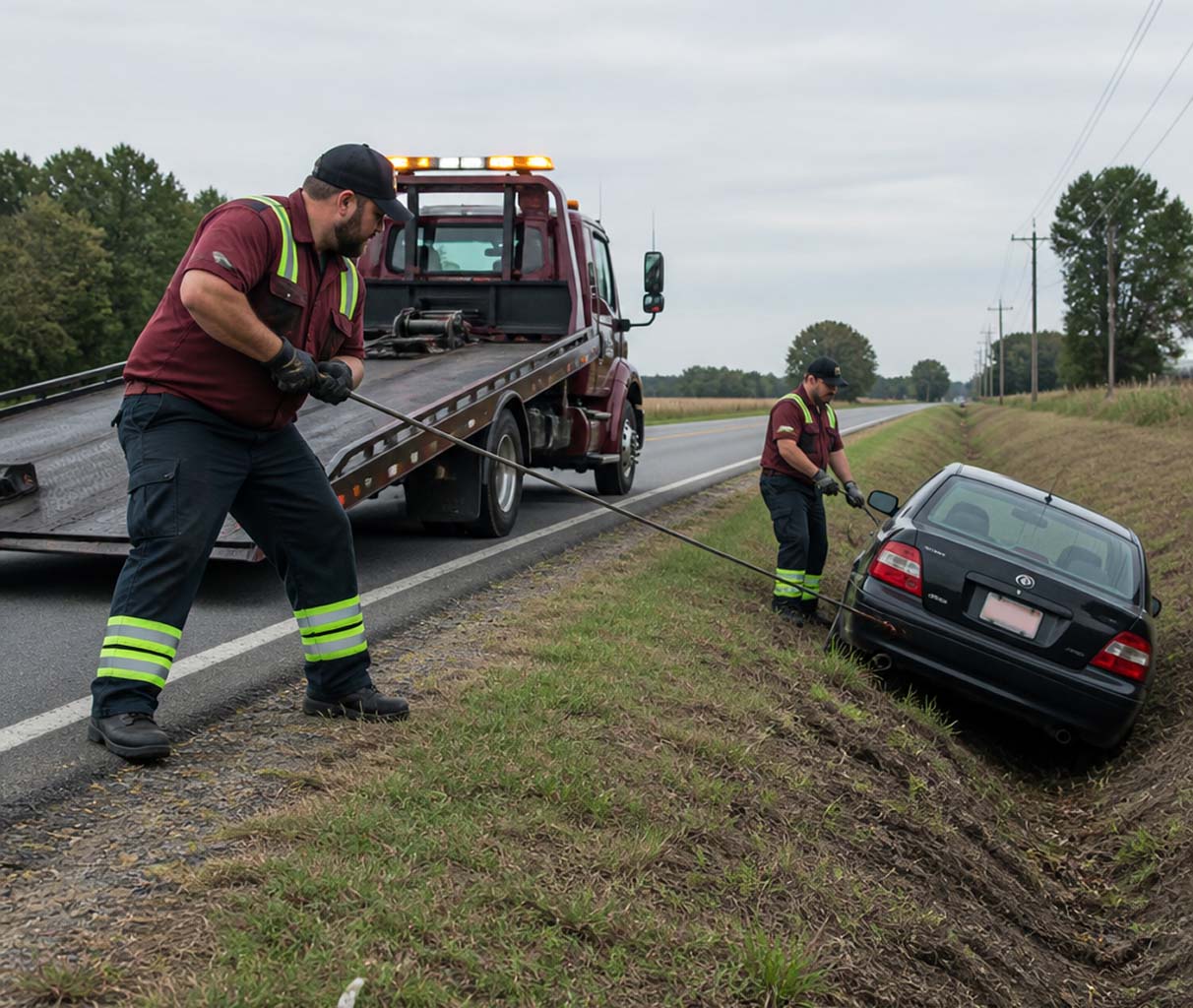
The back tire slips off the edge of a sandy fern-farm road outside Pierson, you press the gas out of instinct, and the car quietly digs itself in deeper. A winch-out is the recovery that pulls a stuck vehicle back onto solid ground with a steel cable and a tow truck's powered winch, and in the rural, sandy stretches of Volusia County it is one of the most common calls a local operator gets. Knowing when you truly need a winch-out, and when trying to drive out will only make things worse, can spare you a bent control arm and a much larger bill.
Key Takeaways
- A winch-out uses a cable and a truck-mounted winch to pull a stuck vehicle straight out, without spinning its tires.
- Spinning your wheels when the car will not move digs it in deeper and can damage the drivetrain and undercarriage.
- Sand, mud, steep shoulders, and being high-centered are the classic signs you need a professional recovery, not another try.
- Florida Statute 316.071 says a driver must get a disabled vehicle out of the flow of traffic, but never at the cost of personal safety.
- A clear location and an honest description of how you are stuck get the right recovery truck sent the first time.
1. Figure Out How Your Vehicle Is Stuck
Start by naming the situation, because how you are stuck decides whether a winch-out is even the right tool. A vehicle can be bogged in soft sand, sunk in mud after a summer storm, dropped into a roadside ditch, or high-centered on a ridge with its wheels barely touching. Around Pierson and the western edge of Volusia County, near the Ocala National Forest, sandy shoulders and unpaved farm roads produce more of these calls than potholes ever do.
The distinction matters because the fixes are different. A vehicle that has simply lost traction on a flat, sandy patch may need only a firm surface under the drive wheels, while one that is high-centered has its weight resting on the frame and cannot move until it is lifted or pulled free. A car nosed into a ditch adds gravity and a bad angle to the problem. Naming which of these you are facing is the first real decision, and it shapes every choice that follows.
2. Look at What Is Under and Around the Car
Before you do anything, take stock of the ground and the surroundings. Check how deep the tires have sunk, whether the frame is resting on dirt or sand, and how much clearance is left underneath. Then look outward: standing water in a ditch, a steep slope, soft mud that swallows your shoes, or fast traffic on a road like US-17 all change the math and can turn a simple recovery into a dangerous one.
3. Decide Whether It Is Safe to Try Self-Recovery
Only the mildest cases are worth a do-it-yourself attempt. If a single tire is barely off firm ground, traction mats, floor mats, or a gentle rock between drive and reverse may free the car. Florida Statute 316.071 does require drivers to move a disabled vehicle out of the regular flow of traffic, but it does not ask you to risk your safety to do it, and standing in a travel lane on US-17 to push a car is exactly the risk to avoid.
Stop and call for help the moment the vehicle is buried to the axle, high-centered, tilting toward water, or sitting where you would have to work in live traffic. In those conditions every extra push tends to make the recovery harder, not easier.
4. Know When a Winch-Out Is the Right Call
A winch-out is the right call whenever the vehicle needs to be pulled rather than driven out. A truck-mounted winch applies a steady, straight-line pull that moves the car without spinning its tires, which is exactly what a vehicle buried in sand, sunk in mud, or dropped off a shoulder requires. On the loose, sandy roads that thread through the Ocala National Forest and the fern farms around Pierson, that controlled pull is often the only thing that will work.
Professional recovery is also skilled work, not just brute force. The operator has to choose safe anchor points, protect the frame and suspension, and control the angle of the pull so the vehicle is not damaged on the way out. Florida Statute 713.78, which covers recovering and towing vehicles, treats that recovery as its own service for good reason, because doing it wrong can bend a frame or tear a bumper loose.
5. What to Tell the Recovery Operator
When you call, a few clear details get the right truck rolling the first time. Give an exact location with a mile marker, cross street, or nearby landmark; explain how the vehicle is stuck and how deep; and describe the vehicle, its drivetrain, and its ground clearance. Mention any water, a steep slope, or traffic nearby, and say whether the engine still runs, so the operator arrives with the right equipment for a winch-out instead of guessing.
Where Vehicles Most Often Get Stuck Around Pierson
A few local settings account for most winch-out calls in this part of Volusia County. Soft, sandy shoulders along US-17 grab a tire the instant a driver drifts off the pavement to check a problem or make room. Unpaved fern-farm and county roads around Pierson, DeLeon Springs, and Barberville turn slick and rutted after rain, and roadside ditches fill fast during summer storms.
Farther out, the sandy forest roads that branch off State Road 40 through the Ocala National Forest, and the boat ramps and soft riverbanks along the St. Johns River on the county's western edge, catch drivers who venture past firm ground. In every one of these spots the surface gives way faster than people expect, which is why a straight-line winch pull, not more throttle, is what actually gets the vehicle out.
Recovery Is Priced Differently From a Basic Tow
A winch-out is usually billed as its own service on top of, or instead of, a standard tow, because it takes extra time, equipment, and skill. Recovery guides commonly place a straightforward winch-out in the range of roughly $50 to $250, with more difficult pulls, deep mud, steep angles, or a second truck for anchoring running higher; these are general market ranges, not a fixed quote. The cleaner the access and the less the vehicle is buried, the lower the labor involved.
That is one more reason not to keep spinning the tires while you wait. A car that has settled only a few inches is a quick pull, while one buried to the frame can require far more work to free safely. Getting an honest recovery quote up front, and describing the situation accurately, keeps the number predictable.
If the tires are spinning and the car is not moving, stop. Every extra second of throttle digs the vehicle deeper, packs sand around the frame, and turns a quick winch-out into a longer, costlier recovery.
The Judgment Call That Saves Your Undercarriage
If you remember only one thing, make it this: the moment your tires spin without the car moving forward, take your foot off the gas. That single judgment call is what separates a five-minute pull from a bent control arm, because spinning wheels dig deeper, pack sand against the undercarriage, and heat up a drivetrain that was never meant to run in place. Read the ground, keep yourself out of traffic, and be honest about whether the car can safely move on its own. When the answer is no, that is the time for a professional winch-out; Pierson Towing handles off-road recovery and roadside assistance across Pierson, DeLeon Springs, Barberville, and the rest of north Volusia County, and can pull a stuck vehicle out without adding to the damage.