
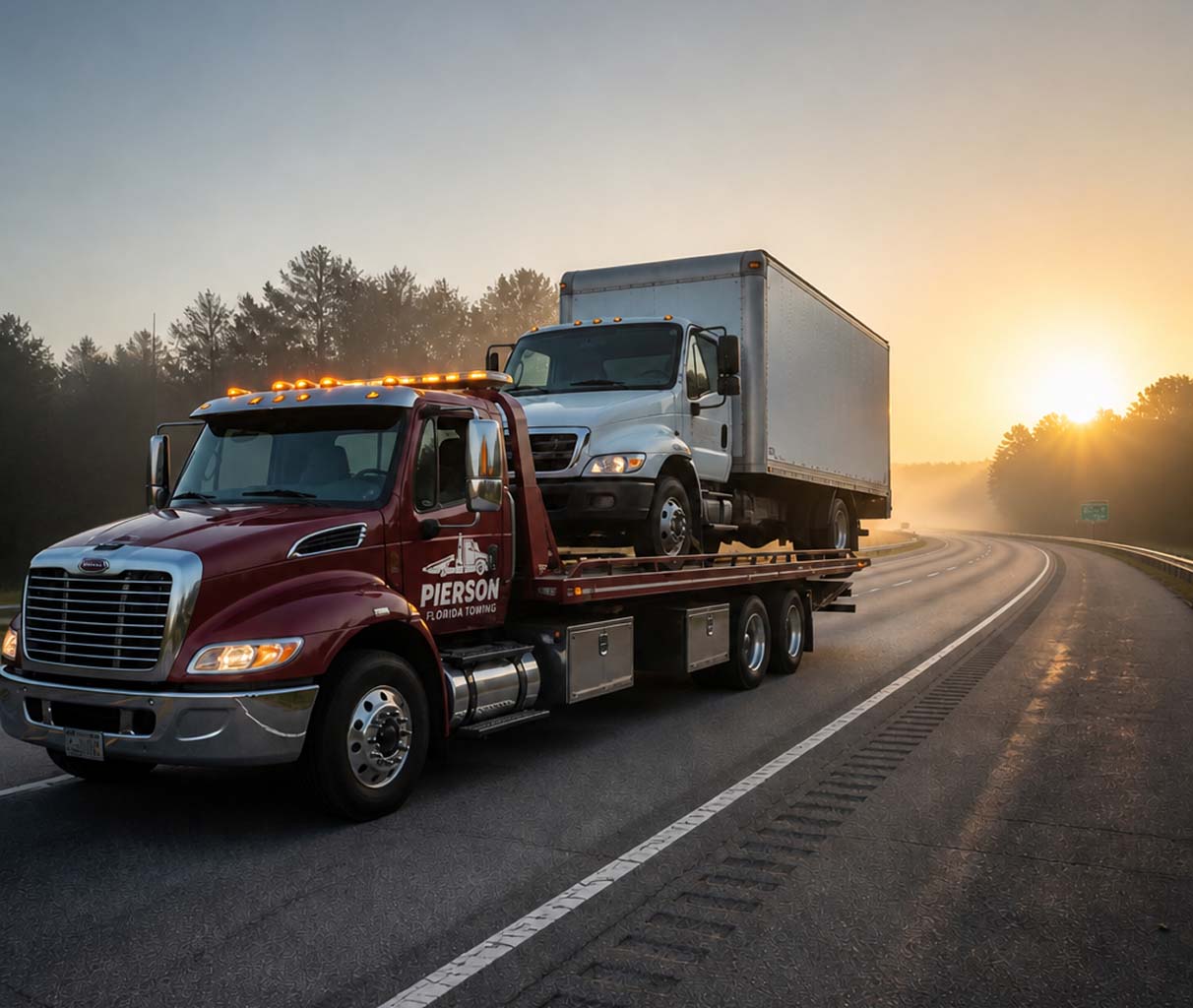
Drive US-17 through Pierson on any weekday and you pass the tools of the fern business: flatbed trailers stacked with cuttings, utility trailers behind farm pickups, the occasional boat headed for the St. Johns. Most of those rigs are loaded by feel, and feel is exactly what gets drivers into trouble. Knowing what your truck can safely tow is not about the biggest number in a brochure. It is about matching a real load to the weakest part of your vehicle, staying inside Florida's trailer rules, and keeping control on a two-lane road. Here is how to work out your truck's honest limit before you ever hitch up.
- Your towing capacity is set by the weakest link in the chain, not by the trailer alone.
- The numbers that matter are GVWR, GCWR, payload, and tongue weight; the brochure max-tow figure rarely applies to a loaded truck carrying passengers.
- Tongue weight should land around 10 to 15 percent of the loaded trailer's weight for stable towing.
- In Florida, a trailer with a gross weight over 3,000 pounds must have brakes on all wheels plus a breakaway system.
- Safety chains are required on nearly every rear-hitch trailer in Florida, and most trailers may be no wider than 102 inches.
- Exceeding your rating risks overheated brakes, blown trailer tires in the Florida heat, and trailer sway you cannot recover from.
What Does Towing Capacity Actually Mean?
Towing capacity is the maximum weight a manufacturer certifies your vehicle can pull safely, and it is only as high as the weakest component involved. A truck is a system: the engine and transmission move the load, the frame and hitch carry it, the axles support it, and the brakes stop all of it. The rating reflects whichever of those gives out first, which is why a half-ton pickup and a three-quarter-ton version of the same model can have very different limits. That number also assumes a specific setup: a certain cab, bed, axle ratio, and often a factory tow package. Change any of those and the real figure changes with it. The advertised up-to capacity on a window sticker almost always describes a stripped-down configuration with a driver and nothing else aboard. Load three passengers, a cooler, and a bed full of gear, and the weight you can still put behind the truck drops fast. Treat towing capacity as the ceiling of a whole system, not a single headline number.
Which Numbers Decide What You Can Pull?
Four ratings do most of the work, and they are not interchangeable. Towing capacity is the trailer weight your truck can pull. GVWR, the gross vehicle weight rating, is the most the truck itself may weigh fully loaded, so truck, people, cargo, and the trailer's tongue weight all count against it. GCWR, the gross combined weight rating, caps the truck and the loaded trailer together. Payload is what you can put inside the truck, and here is the catch most drivers miss: the trailer's tongue weight eats into payload before a single bag of mulch does. Tongue weight is the downward force the coupler puts on the hitch, and balance depends on it. Trailer-use guidance published by the University of Virginia advises that tongue weight run about 10 to 15 percent of the loaded trailer's weight; too little and the trailer fishtails, too much and the truck's steering goes light. The table below sorts out the terms and where to find each one.
| Rating | What it tells you | Where to find it |
|---|---|---|
| Towing capacity | Maximum trailer weight the truck can pull | Owner's manual or VIN tow guide |
| GVWR | Maximum loaded weight of the truck itself | Driver's door-jamb sticker |
| GCWR | Maximum weight of truck and trailer combined | Owner's manual or tow guide |
| Payload | Weight of people and cargo the truck can carry | Yellow door-jamb sticker |
| Tongue weight | Downward force the trailer puts on the hitch | A tongue scale or public scale |
How Do You Find Your Truck's Real Limit?
Start with the yellow sticker inside the driver's door jamb, which lists your exact truck's payload and GVWR for the configuration you actually own. For towing capacity and GCWR, use the manufacturer's towing guide for your model year and look up your specific cab, drivetrain, and axle ratio rather than the top-line number. Then do the subtraction that keeps you honest. From payload, take away the weight of every passenger, everything in the cab and bed, and the trailer's tongue weight; whatever is left is your margin. From GCWR, subtract your truck's actual loaded weight to find the heaviest trailer you can legally pull. The only way to know your loaded weight for certain is to drive onto a public scale, and truck stops near DeLand run certified scales that weigh each axle for a few dollars. A quick trip to a scale replaces a guess with a number you can trust.
What Does Florida Law Require When You Tow a Trailer?
Florida sets hard rules that sit on top of your truck's ratings, and they apply on every road around Pierson. Under Florida Statute 316.261, any trailer or semitrailer with a gross weight over 3,000 pounds must have brakes on all wheels, and those brakes must apply automatically and hold for at least 15 minutes if the trailer breaks away from the truck. A loaded utility or equipment trailer crosses that threshold more easily than most owners expect. The connection itself is regulated too. Florida Statute 316.530 requires safety chains, cables, or an equivalent device on a trailer towed by a rear hitch, with fifth-wheel setups and slow farm equipment as the main exceptions, and the drawbar generally may not exceed 15 feet. Size matters as well: under Florida Statute 316.515, most trailers and their loads may be no more than 102 inches wide and 13 feet 6 inches tall, and a noncommercial truck-and-trailer combination may not exceed 65 feet overall. An overweight, unbraked, or oversized trailer is a ticket and a liability waiting to happen.
What Happens When You Exceed the Limit?
Going over your rating rarely fails all at once; it fails at the worst moment. The transmission runs hot hauling more than it was built for, and heat is what kills transmissions. Your brakes, sized for the truck's own weight plus its rated trailer, fade on a long pull or a panic stop, so stopping distance stretches exactly when you need it short. Overloading also punishes tires. Trailer tires carry a weight rating for a reason, and in the Florida heat an over-loaded, under-inflated tire builds the internal temperature that leads to a blowout. Then there is sway: too little tongue weight, or too much trailer behind a light truck, sets up a fishtail that gets worse the faster you go. Towing past the manufacturer's limit can also void the driveline warranty and wears the hitch, axles, and frame faster than normal. The capacity number is not a dare; it is the line past which the odds turn against you.
What Changes the Answer Around Pierson?
Local roads and loads shift the calculation in north Volusia County. US-17 is a two-lane highway for much of its run through Pierson, Barberville, and Seville, with narrow shoulders and crossing farm traffic, so a trailer that merely fits is not the same as one you can control when a loaded fern truck pulls out ahead. The soft, sandy shoulders common out here will grab a tire and pull a heavy rig toward the ditch before you feel it start. Season matters too. Volusia County's humid subtropical summers push pavement temperatures high, and that heat is hard on tires already working near their limit. Boaters heading for Lake George and growers moving equipment between ferneries are towing in exactly these conditions. If a trailer breaks down, or a tire goes and the rig ends up on a soft shoulder, Pierson Towing handles medium-duty towing for larger loads and roadside assistance for tire changes; a bogged-down trailer is a job for off-road recovery and winch-out rather than another try that only digs you in deeper.
Frequently Asked Questions About Towing Capacity
How do I find my truck's towing capacity?
Check the manufacturer's towing guide for your exact model year, cab, drivetrain, and axle ratio rather than the up-to number in an ad. Your payload and GVWR are printed on the yellow sticker inside the driver's door jamb. For a figure you can trust, weigh the loaded truck on a certified scale and compare it against your ratings.
Does Florida require trailer brakes?
Yes. Florida Statute 316.261 requires brakes on all wheels for any trailer with a gross weight over 3,000 pounds, plus a breakaway system that holds the brakes for at least 15 minutes if the trailer separates. Lighter trailers may be exempt if the combination still stops properly.
What is tongue weight, and why does it matter?
Tongue weight is the downward force the trailer's coupler places on the hitch. It should be roughly 10 to 15 percent of the loaded trailer's weight. Too little makes the trailer sway, and too much lightens the truck's steering and overloads the rear axle.
Can I tow more if I install a bigger hitch?
No. A heavier-rated hitch does not raise your truck's towing capacity, because capacity is limited by the weakest part of the whole system, often the frame, brakes, axles, or transmission. Upgrading one part only moves the weak point somewhere else.
- Florida Statutes 316.261, brake equipment on towed vehicles (flsenate.gov)
- Florida Statutes 316.530, towing connections and safety chains (flsenate.gov)
- Florida Statutes 316.515, maximum width, height, and length (flsenate.gov)
- University of Virginia, Use Guidelines for Trailers (uvafinance.virginia.edu)