
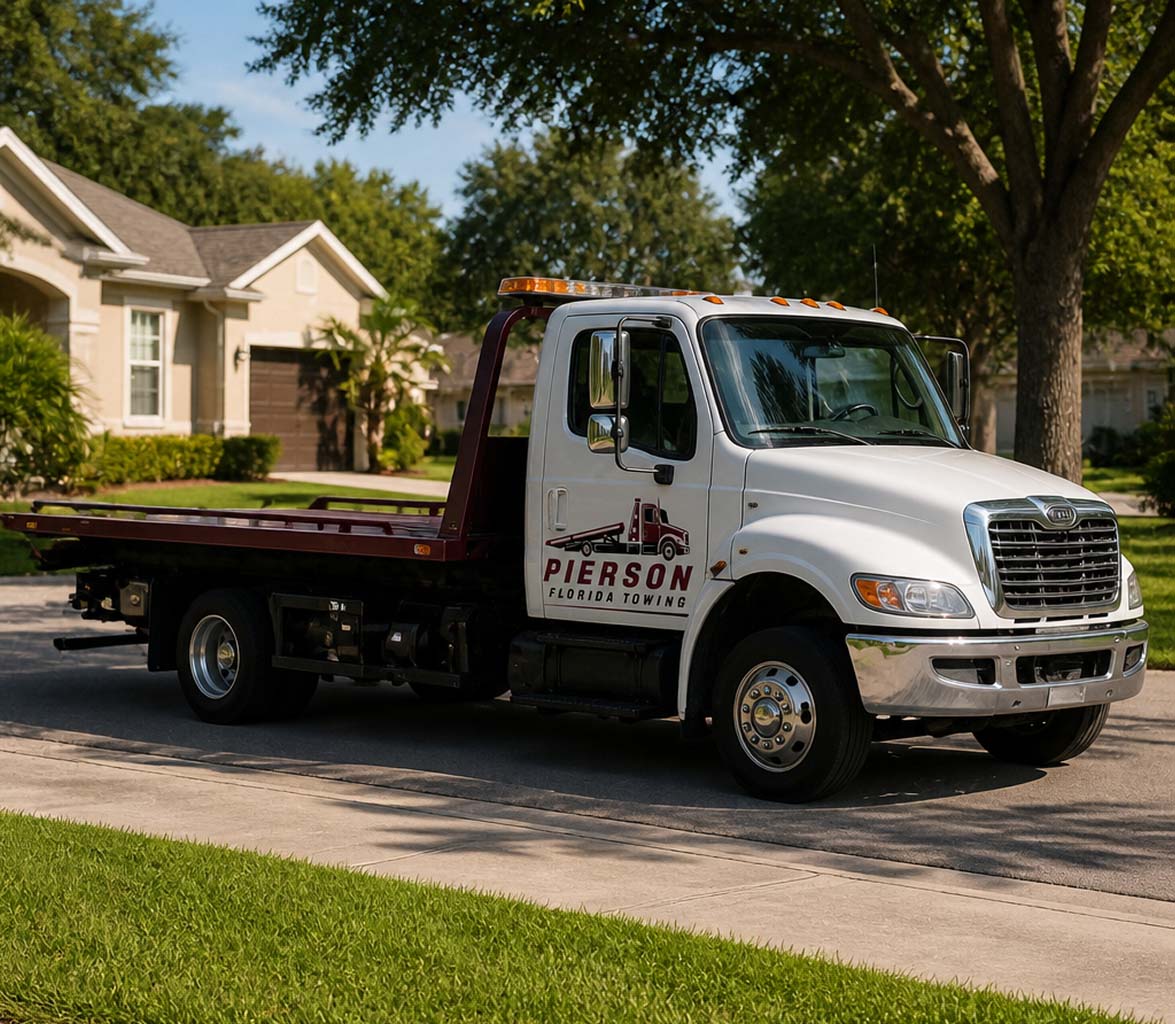
A tow truck in Florida usually runs from a modest flat hook fee up to a few hundred dollars once mileage, the type of truck, and the time of day are added in. If you are waiting on a shoulder along US-17 outside Pierson, though, the number you actually pay depends on details most drivers never think about until the invoice lands. This guide breaks down what really goes into a tow truck cost in Florida, which pieces the state regulates, and how the figures tend to land here in Volusia County so you are not guessing when the bill arrives.
Key Takeaways
- Most local tows are priced as a base hook fee plus a per-mile rate, so distance and truck type drive the total more than anything else.
- Florida Statute 713.78 bars storage charges when a vehicle is held under six hours and caps administrative fees at $250.
- For nonconsent tows, Statute 323.002 requires the operator to disclose the maximum towing and storage charges before your vehicle is ever hooked up.
- Heavy-duty, flatbed, and after-hours recoveries cost more than a standard light-duty tow on a clear afternoon.
- A single flat quote before the truck rolls is the best protection against a surprise on the final bill.
What Does a Tow Truck Actually Cost in Florida?
A tow truck cost in Florida almost always starts with two numbers: a base hook fee that covers dispatch and loading, and a per-mile rate for the drive to the drop-off. Independent cost guides generally put a standard local light-duty tow at roughly $75 to $150 for the first few miles, with an added charge of about $2 to $7 per mile once you pass the included distance. Those are market ranges gathered from national pricing data, not a quote from any one company, but they are a reasonable frame for what a routine call looks like.
Distance matters more in rural north Volusia County than it does in a dense city. A breakdown near Pierson that needs to reach a shop in DeLand can cover close to twenty miles before the vehicle is even unloaded, so the per-mile portion often outweighs the base fee. When the trip crosses county lines or heads out of the area entirely, a flat-rate arrangement for long-distance towing usually beats paying by the mile the whole way.
Why Do Two Tows the Same Distance Cost Different Amounts?
Two vehicles towed the same distance can be billed very differently because the price reflects the equipment and effort, not just the odometer. The truck class is the biggest lever: a light-duty wheel-lift call for a sedan is a fraction of what a medium- or heavy-duty recovery costs for an RV or a box truck. A damage-free flatbed carrier, extra winching to reach a car off the pavement, and calls that come in overnight or during a storm all add to the figure as well.
The condition of the vehicle plays a quiet role too. A car that will not shift into neutral, has locked wheels, or sits with all-wheel drive engaged takes more setup and often a flatbed, which raises the labor involved. The clearer the picture you give the dispatcher, the closer the first quote will be to the final charge.
| Cost factor | What it changes |
|---|---|
| Base hook fee | Flat charge for dispatch, connecting, and loading the vehicle |
| Mileage | Per-mile rate that grows with longer rural or cross-county trips |
| Truck class | Light, medium, or heavy duty; larger vehicles cost more to move |
| Winch-out or recovery | Added labor to pull a vehicle from a ditch, sand, or mud |
| Time of day | Overnight, weekend, and storm calls can carry a premium |
| Storage | Daily fee if the vehicle sits at a lot after the tow |
What Does Florida Law Say About Towing Charges?
Florida regulates the parts of a tow bill most likely to catch drivers off guard. Under Florida Statute 713.78, an operator cannot charge a storage fee if the vehicle is held for less than six hours, and administrative fees are capped at $250; the same law requires written notice to the registered owner and lienholder within five business days when a vehicle is stored. Those rules exist so a short tow does not quietly turn into a storage bill.
For tows you did not request, Florida Statute 323.002 requires the wrecker operator to disclose the maximum towing and storage charges before the vehicle is connected, and it limits administrative fees to no more than 25 percent of the maximum towing rate. When a car is removed from private property, Statute 715.07 adds more protections: the company must file its current rate schedule with local law enforcement, post an identical schedule at the storage site, and release the vehicle within one hour of a request. Knowing these limits turns a confusing bill into one you can actually check.
How Much Is Storage If a Car Sits After a Tow?
Storage is the line item that grows the longer a vehicle sits, and it is easy to control if you act quickly. Daily storage for a passenger vehicle commonly falls in the $25 to $50 range according to industry pricing surveys, though larger vehicles and secured lots run higher. Because Florida law waives storage under six hours, retrieving a car the same day it is towed frequently means paying nothing for storage at all.
If a vehicle is not claimed, Statute 713.78 sets the clock for a lien sale, with public-sale timelines that begin around 35 days for older vehicles and 57 days for newer ones. You never want to reach that point, so call the storage location, confirm the total, and arrange pickup as soon as you can. A quick phone call to the shop or to Pierson Towing is usually enough to stop storage from adding up.
How Can Volusia County Drivers Keep a Tow Affordable?
The most reliable way to control a tow truck cost in Florida is to ask for a flat, all-in quote before the truck is dispatched, including the base fee, the per-mile rate, and any after-hours or recovery charges. Give an accurate location using a mile marker or a nearby landmark, describe the vehicle and whether it runs, and mention all-wheel drive or a low ride height so the right truck is sent the first time. Every wasted trip or wrong-sized truck is money added to the bill.
It also pays to know what you already have. Many auto insurance policies and membership programs include a set number of roadside miles, which can cover a short emergency towing call outright. When you do need help, a local dispatcher who knows the roads between Pierson, DeLeon Springs, and DeLand can quote the mileage accurately instead of estimating high.
The cheapest tow is the one quoted in full before the truck rolls. Ask for the base fee, the per-mile rate, and any after-hours or recovery charge as one number, because Florida's nonconsent rules were written so you can.
Tow Truck Cost FAQs
Is towing cheaper if I have roadside assistance or insurance?
Often, yes. Many insurance policies and auto-club memberships include a set number of towing miles per year, which can cover a short local tow with little or nothing out of pocket. Beyond the included distance you usually pay the standard per-mile rate, so it helps to know your limit before you call.
Does a flatbed cost more than a regular tow?
A flatbed call is typically a little higher than a basic wheel-lift tow because the whole vehicle is loaded and carried rather than partly rolled. For all-wheel-drive, lowered, luxury, or non-running vehicles the flatbed is worth it, since it avoids drivetrain and body damage that would cost far more to repair.
Who pays when police order a tow after a crash?
The vehicle owner is generally responsible for the towing and storage charges after a crash or a law-enforcement-ordered removal. Florida's nonconsent rules still apply, so the operator must be able to show the maximum rates, and your insurance may reimburse part of the cost depending on your coverage.
Can a towing company hold my car until I pay?
Yes. Under Florida Statute 713.78 a towing and storage operator has a lien on the vehicle and can hold it until valid charges are paid, though they must send the required notices and cannot charge storage for a hold under six hours. If you believe a charge is wrong, the statute also lets you post a bond and challenge it in court.
Florida Statute 713.78, Liens for recovering, towing, or storing vehicles and vessels (Florida Legislature) · Florida Statute 323.002, County and municipal wrecker operator systems (Florida Legislature) · Florida Statute 715.07, Vehicles or vessels parked on private property; towing (Florida Legislature)