
Tires carry a temperature grade for how well they shed heat, and NHTSA reports that 62 percent of tires on the road hold the top grade of A, while 34 percent are rated B and 4 percent are rated C. Sustained high temperatures cause deterioration, blowouts, and tread separation, and Florida supplies sustained high temperatures for most of the year. A blowout at highway speed is not a slow leak you notice at the next stop. It is an abrupt handling event that lasts a few seconds, and what you do in those seconds decides how the rest of it goes.
1. Hold the Wheel and Keep Off the Brake
The correct first reaction to a blowout is to grip the wheel firmly with both hands, keep the car pointed straight, and keep your foot away from the brake pedal. A tire that lets go creates sudden drag on one corner of the vehicle, and the car pulls hard toward that side. Braking adds weight transfer to a car that is already unbalanced, and it is the most common way a recoverable blowout turns into a spin.
A front blowout pulls at the steering and feels like the wheel is being taken out of your hands. A rear blowout feels looser, more like the back of the car is swaying on its own. The response is the same either way. Two hands, hold your line, and expect the car to want to travel somewhere you do not want it to go.
2. Let the Car Slow Itself Down
Ease off the accelerator gradually rather than lifting abruptly, and let engine braking and the ruined tire scrub off speed. Below roughly 30 miles per hour the vehicle becomes steerable in the ordinary sense again, and only then is gentle braking worth using.
This part feels wrong while it is happening. The instinct after a loud bang is to stop as fast as possible, and riding out several seconds of noise and vibration at speed takes deliberate effort. The rim will survive it, and a rim is cheaper than the alternative. In most cases it is already finished anyway, from the moment the tire came apart.
3. Pick Where You Stop, If You Get a Choice
Choose the stopping spot for distance from traffic, not for how soon you can reach it. The ideal is a paved area well clear of the travel lane, on a straight stretch, where drivers coming up behind you can see the car from a long way off. A wide driveway or a business lot fifty yards ahead beats a narrow shoulder right here.
On the rural stretches of US-17 through Pierson, Seville, and Barberville, that choice often does not exist. The shoulders are narrow, frequently soft grass or sand rather than pavement, and they fall away into a drainage ditch a few feet off the white line. Pulling too far off puts two wheels somewhere the car cannot climb back out of, which turns a tire change into a recovery job. When the shoulder is soft, stay closer to the pavement than instinct suggests, and get the hazard lights on before the car has fully stopped. Avoid stopping on a curve or just past a rise, where nobody sees you until they are on top of you.
4. Decide Whether You Should Be Outside the Car
Getting out to inspect the damage is a judgment call, and on a two-lane road with no real shoulder the safer answer is usually no. Traffic passing at highway speed a few feet from your door is a bigger hazard than anything a visual check is going to tell you. If you do get out, exit on the side away from traffic and stand well off the road, behind a guardrail or up the embankment, never beside the car and never between the car and oncoming traffic.
Florida's Road Ranger program provides free highway assistance, including tire changes and jump starts, and you request one by dialing *347 from a mobile phone. Its patrols concentrate on congested areas and high-incident freeway locations, so on I-4 or I-95 a Road Ranger may well reach you. North of DeLand on US-17, that is not the coverage to plan around.
5. Know Whether the Spare Is Actually an Answer
A spare solves the problem only when the damage is confined to the tire, the wheel is undamaged, and there is somewhere safe to do the work. Those three conditions fail together more often than people expect. A blowout at speed frequently takes the sidewall apart in a way that scores the rim, tears a wheel well liner, or pulls out a brake line or an ABS sensor wire, and none of that is visible while the car is still on the jack.
The spare itself deserves a look before you count on it. NHTSA notes that spare tires are prone to aging because they are seldom replaced, and recommends that full-size spares not be used as a replacement for worn tires except in emergencies. A compact temporary spare is speed-limited and distance-limited by design. Many vehicles sold in the past decade carry a sealant kit and an inflator instead of a spare at all, and a sealant kit does nothing for a tire that has come apart.
Then there is where you would be standing. Changing a wheel on the traffic side of a car on a narrow shoulder is genuinely dangerous work, and doing it on soft sand risks the jack sinking under load. When the ground is soft or the shoulder is tight, roadside assistance or a tow is the safer call even when the spare is perfectly good.
6. Reduce the Odds Before the Season Does It for You
Heat and underinflation are the two ingredients in most blowouts, and both are manageable. NHTSA advises filling each tire to the vehicle manufacturer's recommended pressure, which is printed on the driver's door jamb rather than on the tire sidewall, and notes that only about one driver in five keeps tires properly inflated. An underinflated tire flexes more, runs hotter, and fails sooner, which is why a tire that was fine in February gives up in August.
The rest is quick to check. Tread should be replaced at 2/32 of an inch, which the penny test will tell you in a few seconds. Age matters on its own, and some manufacturers recommend replacement at six to ten years regardless of tread depth; the last four digits of the DOT code on the sidewall give the week and year of manufacture. NHTSA's summer driving guidance also covers belts and hoses, which should be checked for bulges, blisters, cracks, and cuts, and recommends carrying a basic kit with a charged phone, a flashlight, water, and a first aid kit. On a rural route where help is not five minutes away, that kit earns its space.
Blowout Questions Volusia County Drivers Ask
Should I brake during a tire blowout?
No. Keep your foot off the brake until the vehicle has slowed to roughly 30 miles per hour and is tracking straight. Braking immediately shifts weight onto a car that has already lost grip at one corner, and it is the most common cause of losing control. Ease off the accelerator instead and let the car decelerate on its own.
Can I drive on a blown tire to reach an exit?
Only for a very short distance at very low speed, and only when stopping where you are is unsafe. Running on a destroyed tire damages the rim quickly and can tear brake lines, ABS wiring, and the wheel well liner, which turns a tire bill into a much larger repair. A few hundred feet to reach a safe pull-off is reasonable. A few miles to reach a preferred shop is not.
Does my car even have a spare tire?
Many newer vehicles do not. Manufacturers increasingly ship a sealant kit and a compact inflator instead, and some include neither. Check the trunk well and the owner's manual now rather than on the shoulder of US-17, and if there is a spare, check its pressure whenever you check the other four.
Is a tire blowout covered by roadside assistance?
Usually yes for a tire change, though terms vary by policy or motor club and coverage generally assumes a usable spare is present and the vehicle is somewhere the work can be done safely. When there is no spare, the wheel is damaged, or the car is sitting on soft ground, the job becomes a tow rather than a tire change.
What if the car slid off into the ditch?
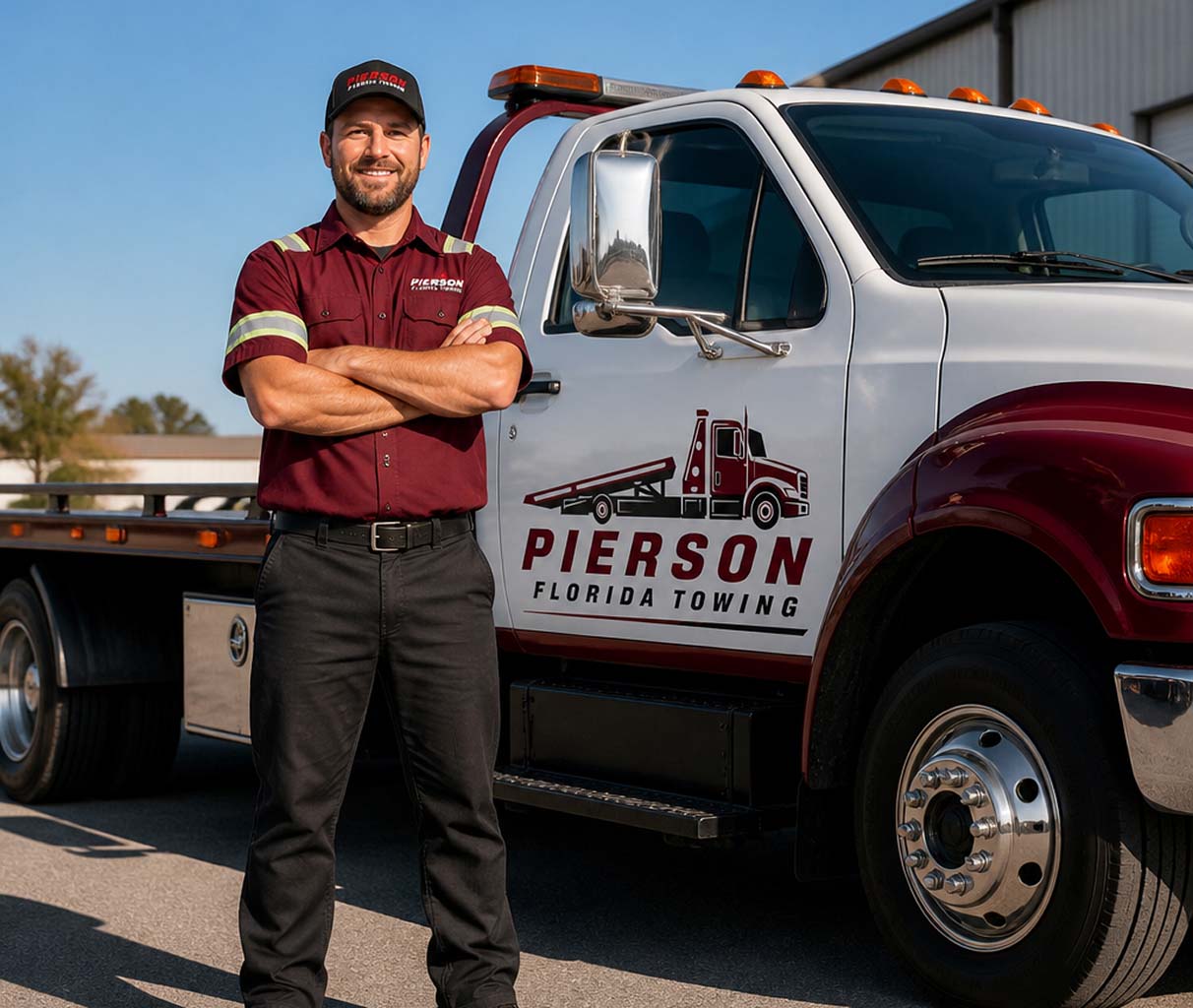
That is a recovery rather than a tire change. A vehicle that has dropped a wheel off a soft shoulder usually cannot be driven out without digging in further or damaging the undercarriage, and it needs a winch. Stay out of the travel lane, leave the hazards on, and describe the position and the ground conditions when you call so Pierson Towing sends the right truck for an off-road recovery rather than a standard tire call.
Tires, National Highway Traffic Safety Administration. Summer Driving Tips, National Highway Traffic Safety Administration. Road Rangers, Florida Department of Transportation.