
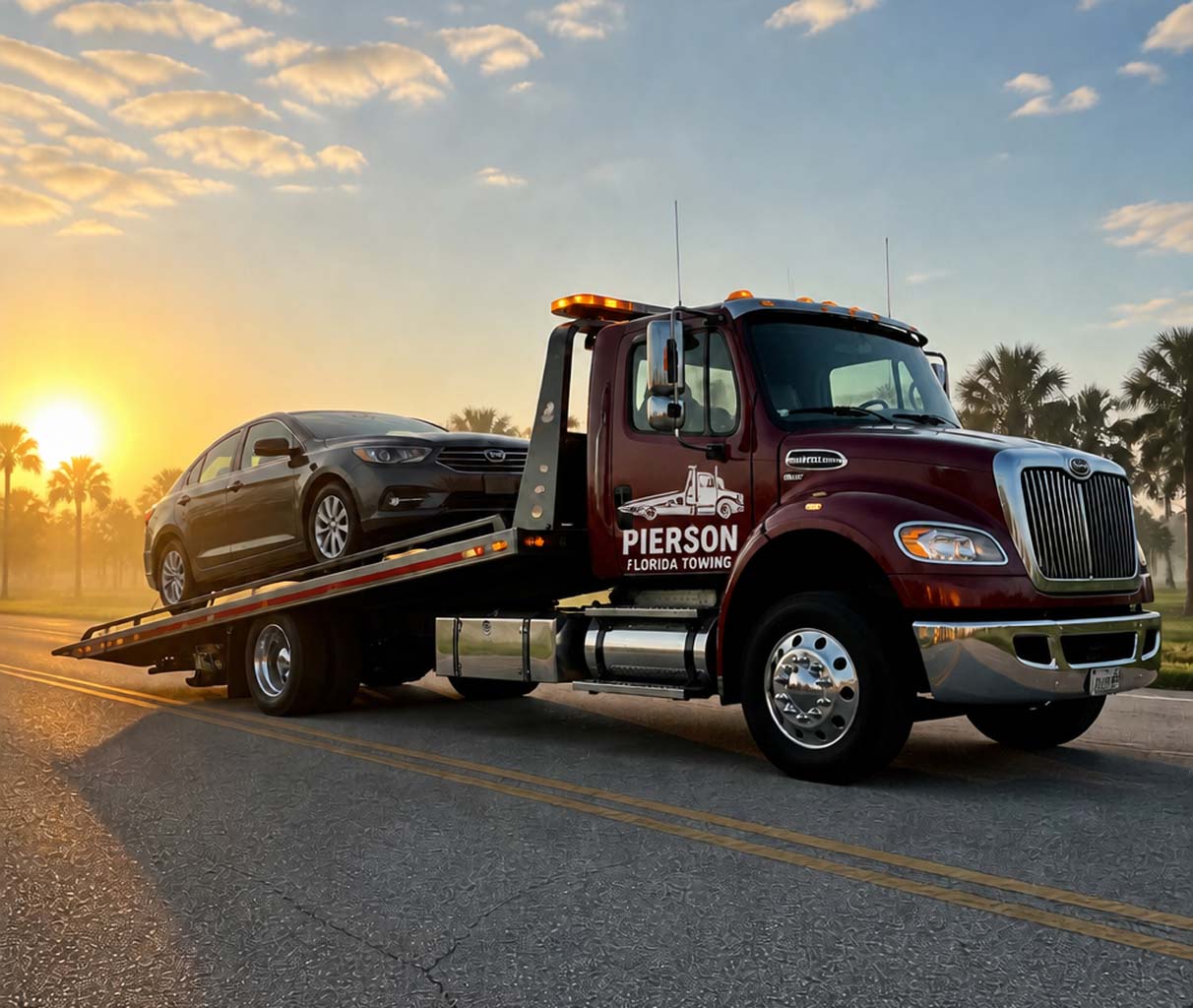
An RV that stops running is a bigger problem than a car that stops running, and not only because of the weight. A 34-foot motorhome on the shoulder of US-17 blocks more sightline, takes longer to get off the road, and cannot be handled by the truck that would happily haul a sedan. If you tow a travel trailer or drive a Class A through north Volusia County, the useful preparation is knowing which kind of help your rig actually needs before the day you need it.
Size and Weight Decide Who Can Come Get You
The first question a dispatcher asks about an RV is not what broke, it is how big the rig is, because that determines which truck gets sent. Florida caps motor homes at 45 feet in length, and Florida Statute 316.515 sets a general height limit of 13 feet 6 inches including the load and a width limit of 102 inches, with non-commercial RVs allowed to exceed that width only when the overage comes from manufacturer-installed mirrors. Those numbers are the outer edge of what is legal on the road, and a rig near any of them is squarely medium-duty or heavy-duty work.
Length alone does not settle it. A 30-foot Class C on a van chassis and a 30-foot Class A on a commercial chassis weigh very different amounts and need different equipment. Have the numbers from the door placard or the owner's manual ready: gross vehicle weight rating, length, and whether it is front-wheel, rear-wheel, or a diesel pusher. That one exchange saves a wasted truck roll and a second wait.
A Trailer and a Motorhome Are Two Different Recoveries
A travel trailer breakdown usually is not a trailer problem at all. In most cases the tow vehicle failed and the trailer is simply attached to it, which means two units have to leave the shoulder, sometimes on two trucks. A motorhome breakdown is one unit, but a much harder one, because everything that moves it is under the same roof as everything you own.
The distinction matters for what you do while you wait. A trailer can often be unhitched and left in a safe spot if there is one, which frees the tow vehicle to be moved. A motorhome cannot be split, so it stays where it is until the right truck arrives. Do not unhitch on a soft shoulder or a slope. A trailer that rolls or settles into sand turns a straightforward tow into a winch job, which is a different call and a different truck.
There is a middle case worth naming. A fifth wheel with a dead tow vehicle is two recoveries staged in sequence, because the trailer has to come off the hitch somewhere it can safely sit while the truck is dealt with. On a rural highway that place frequently does not exist within sight, and the trailer ends up traveling first.
The Hitch Is a Legal Component, Not Just Hardware
Florida law treats the connection between two vehicles as regulated equipment, and roadside is where people discover their setup does not comply. Under Florida Statute 316.530, when one vehicle draws another the drawbar or other connection may not exceed 15 feet, a white flag or cloth not less than 12 inches square has to be displayed on that connection, and safety chains, cables, or other safety devices complying with 49 C.F.R. subpart F must be attached in addition to the coupling, strong enough to maintain the connection under all conditions.
The federal side is more specific about the chains themselves. Under 49 C.F.R. 393.70, a safety device must have an ultimate strength of not less than the gross weight of the vehicle being towed, must have no more slack than is necessary to let the vehicles turn properly, and where two chains or cables are used they attach at points equally distant from and on opposite sides of the longitudinal centerline of the towing vehicle. A tow-bar has to be structurally adequate for the weight drawn, properly and securely mounted, and fitted with a locking device that prevents accidental separation.
The practical reading: crossed chains with a little slack, rated for the trailer's loaded weight, and a coupler latch that actually locks. Most trailer separations trace back to one of those three rather than to a dramatic failure.
What Fits on Which Truck
| Your rig | What usually handles it | What changes the answer |
|---|---|---|
| Pop-up or small utility trailer | Light-duty wrecker or flatbed | Whether the tow vehicle also needs moving |
| Travel trailer up to roughly 30 feet | Medium-duty, often two units moved separately | Soft shoulder, blocked axle, bent frame |
| Class B or Class C motorhome | Medium-duty flatbed or wheel-lift | Drive configuration and ground clearance |
| Class A motorhome or diesel pusher | Heavy-duty with air-brake capability | Length, weight rating, whether it rolls |
| Fifth wheel with a disabled truck | Two trucks, staged | Where the trailer can safely be dropped |
The right-hand column is why an accurate description on the phone matters more than an accurate diagnosis. Nobody expects you to know why it died. Everybody needs to know how big it is, whether the wheels turn, and what it is sitting on.
Where RVs Get Into Trouble Around Pierson
Most of the local difficulty is the road network rather than the vehicles. US-17 through Pierson, Seville, and Barberville is two lanes with narrow shoulders that fall away into drainage ditches, and there are long stretches with nowhere to put a 35-foot rig completely clear of traffic. The side roads toward the St. Johns River and the campgrounds near Astor add soft sand, low limbs, and turnarounds that were never sized for a motorhome.
That combination produces two recurring situations. The first is a rig that is running fine but has put a wheel off a soft shoulder while trying to make room, which is a winch-out rather than a tow. The second is a rig that has committed to a road or a driveway it cannot back out of, usually after a navigation app treated a clay lane as a through route. Neither is a mechanical failure, and both need a truck with a winch and an operator who knows which local roads will carry weight.
The seasonal layer is worth noting too. Summer heat is hard on RV tires, which spend most of the year parked and carry far more weight per tire than a car does, and the afternoon storms that soak these shoulders through the summer mean ground that held a rig in the morning may not hold it at five. The agricultural and log truck traffic on US-17 adds the last piece: a stopped rig is sharing a narrow road with vehicles that need real distance to react.
What to Do in the First Few Minutes
Get everyone out of the travel lane first, on the side away from traffic, and well back from the rig rather than standing beside it. Hazards on immediately. If you carry reflective triangles, set them out behind the rig, further back than feels necessary on a road where traffic is moving at 55.
Then gather what dispatch needs: length, approximate weight, whether it rolls and steers, what surface it is on, how far off the pavement it sits, and whether anything is attached to it. Note the nearest cross street or mile marker, because on a rural highway a location described as between Pierson and Seville is not a location. If pets are aboard, say so on the first call. In Florida heat a rig without shore power or a generator loses its cooling quickly, and that changes the priority of the dispatch.
The Size of the Rig Decides the Phone Call
Everything about an RV breakdown flows from one number you should already know: how big the thing is, loaded. Keep the length, the gross weight rating, and the drive configuration somewhere you can read them out under stress, because that determines whether the answer is a flatbed, a wheel-lift, or a heavy wrecker, and getting it right the first time is usually the difference between a two-hour wait and a five-hour one. Everything else, including what actually broke, can be sorted out later at a shop.
If the rig is drivable but the trailer connection looks marginal, fix that before the trip rather than on the shoulder. And if you are stopped on US-17 with a motorhome that will not move, or a trailer that has slid off into a ditch, Pierson Towing runs medium-duty towing and off-road recovery across north Volusia County with equipment sized for rigs a standard wrecker cannot touch.
Florida Statute 316.515, Length, width, and height of vehicles, Florida Legislature. Florida Statute 316.530, Towing requirements, Florida Legislature. 49 C.F.R. 393.70, Coupling devices and towing methods, eCFR.