
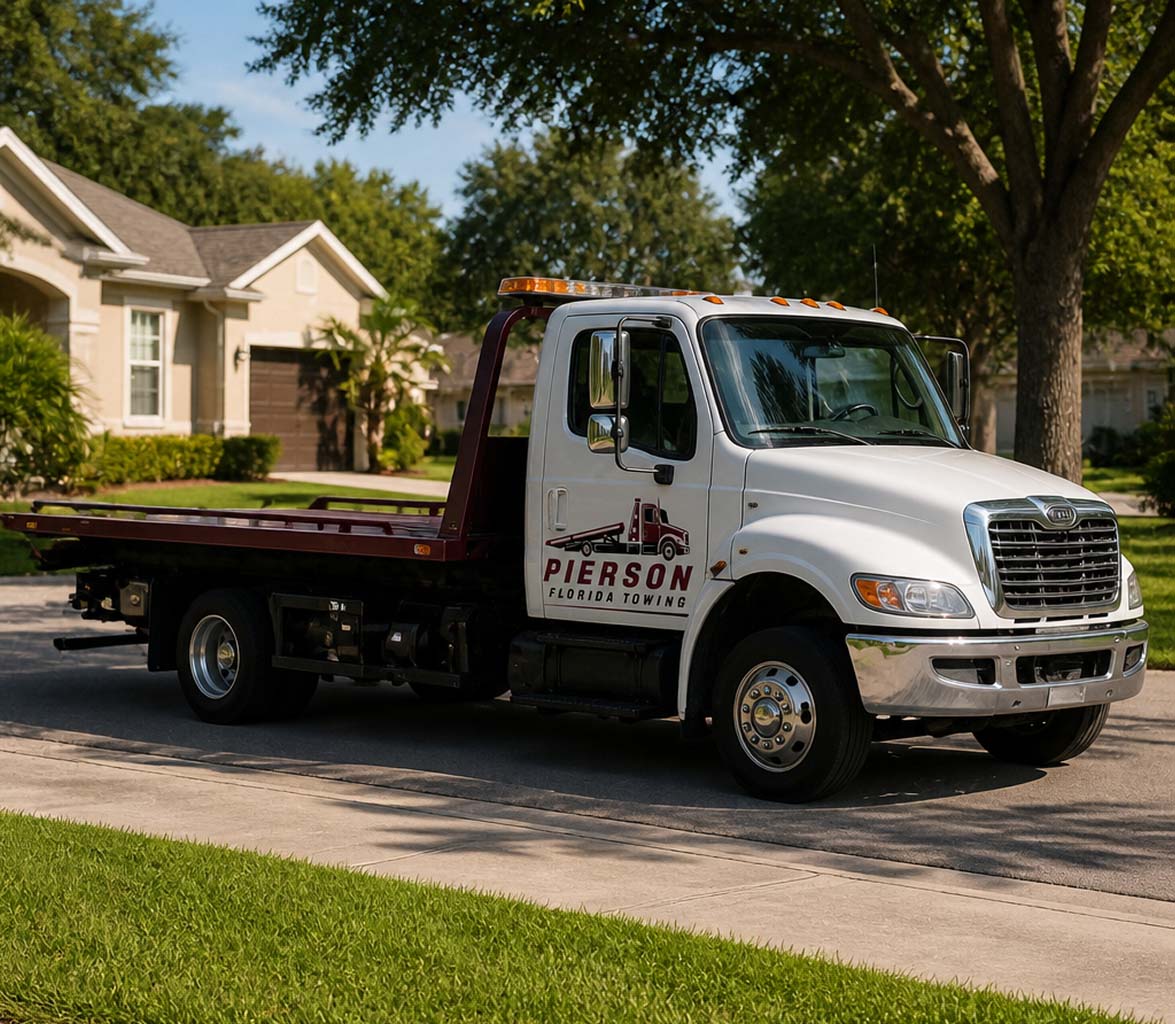
Long-distance towing and car shipping both move a vehicle from one city to another, but they are not the same service, and choosing the wrong one can cost you time or money. Long-distance towing is a tow company hauling your car on its own truck straight to the destination. Car shipping is a national auto-transport network loading your car onto a large multi-vehicle carrier that runs set routes. For drivers around Pierson and north Volusia County, the right choice usually comes down to how far the car is going, whether it runs, and how firm your timing needs to be. Here is how each one actually works, and when to pick it.
Long-Distance Towing Means One Truck, One Vehicle, Door to Door
Long-distance towing is a single tow truck carrying your vehicle directly from pickup to drop-off, with no other cars sharing the trip. A local operator loads your car onto a flatbed or lifts it with a wheel-lift, secures it, and drives it to the address you give: a dealership in Orlando, a shop in Jacksonville, or a relative's driveway a few hundred miles away. Because the truck is dedicated to your car, the pickup happens on your schedule and the car arrives the same day on most in-state runs. The vehicle stays on one bed the whole way, which matters for a car that does not run, sits low, or has already been damaged. Federal rules require that a vehicle on a transporter be restrained at both the front and rear against movement in every direction using at least two tiedowns, under 49 CFR 393.128, so a properly loaded flatbed keeps the car locked in place over long stretches of highway. From Pierson, that door-to-door pickup is the real advantage: the truck comes to you on US-17 instead of asking you to deliver the car somewhere first.
Car Shipping Means a Broker, a Carrier, and a Multi-Car Hauler
Car shipping, also called auto transport, moves your vehicle as one of several on a large open or enclosed carrier that follows regional and cross-country routes. In most cases you book through a broker, who posts your job to a network and assigns it to a carrier with space heading your direction. That carrier consolidates cars from different customers, which is what keeps the per-mile price down on long hauls but also means pickup and delivery happen within date ranges rather than at an exact hour. Any company hauling vehicles for hire across state lines has to be registered with the federal government: interstate for-hire carriers must have a USDOT number, and a broker or carrier arranging transport of regulated freight must also hold operating authority, an MC number, which in turn sets the insurance they are required to carry. That paperwork is worth checking, because on a multi-car hauler your vehicle is one of eight or ten, not the only job the driver has that day.
How the Two Compare on Cost, Speed, and Distance
The clearest way to see the difference is side by side. Long-distance towing is usually priced as a flat rate for the trip, quoted up front for your specific route, and it shines on shorter long-distance moves where a dedicated truck costs little more than shared space would. Car shipping is priced by the mile, and that rate per mile keeps falling the farther the car travels, which is why it tends to win on true cross-country distance. Timing runs the other way: a dedicated tow can often go the same day, while a shared carrier trades speed for the lower rate.
| Factor | Long-Distance Towing | Car Shipping |
|---|---|---|
| Best for | One car, shorter long hauls, exact timing | Cross-country moves, multiple cars, flexible dates |
| How it is priced | Flat rate for the route | Per mile, dropping over distance |
| Typical timing | Often same day in-state, scheduled to your window | Pickup and delivery within date ranges |
| Pickup | Door to door from your address | Door to door or terminal, route dependent |
| Non-running car | Handled routinely on a flatbed | Sometimes refused, or costs extra |
| Distance sweet spot | Local to a few hundred miles | Several hundred miles to cross-country |
When Long-Distance Towing Is the Right Call
Choose long-distance towing when the vehicle cannot drive itself, when there is only one car, or when the timing has to be exact. A car that will not start, a wreck headed to a body shop, a project car with no plates, or a lowered vehicle that would scrape a carrier ramp all belong on a dedicated flatbed. It is also the practical choice for moves that stay inside Florida or reach a neighboring state. A car going from Pierson to Orlando, Tampa, Jacksonville, or up into Georgia is close enough that a single truck is efficient. There is a geography reason too. Pierson sits on US-17, well off the interstate corridors that big auto-transport haulers prefer, so a national carrier may ask you to meet the truck near I-4 or I-95 rather than detour into north Volusia. A local company already works US-17 through DeLand and can pick the car up in your driveway in Barberville, Seville, or DeLeon Springs without that extra step.
When Car Shipping Makes More Sense
Car shipping earns its keep on long distance and volume. If the car is going across the country, from Florida to Texas, Arizona, or California, the per-mile rate on a shared carrier usually beats paying one truck to make that entire drive. It is also the sensible route when you are moving more than one vehicle, when your dates are flexible, or when you are a snowbird sending a car north for the season and back. The tradeoffs are timing and handling: pickup and delivery arrive in windows, your car may ride in an upper or lower slot alongside other vehicles, and a terminal-to-terminal option can add a step if no carrier serves your exact address. Timing matters in Florida in particular. Snowbird season pushes auto-transport demand up as cars flow south in the fall and back north in the spring, so booking a shared carrier around those peaks can mean longer waits and higher rates in and out of the state. For a running car with a flexible schedule and a long way to go, none of that is a dealbreaker, and the savings over that distance are real.
What to Check Before You Book Either One
Before you hand over the keys either way, do a few checks that protect the car and your money. Confirm the company is legitimate: for anything crossing state lines, look up the USDOT number and, for a broker or for-hire carrier, the operating authority that also confirms required insurance is in place. Get the quote in writing, with the route, the dates, and what is and is not covered if something goes wrong. Ask how the car will be secured and, for shipping, whether it rides open or enclosed and in which position. Ask specifically how the car is insured while it is being moved, because a carrier's cargo coverage is separate from your own auto policy, and knowing the limits and any deductible before pickup saves an argument if there is a scratch at delivery. Walk around the vehicle at pickup and photograph it from every side with a timestamp so the condition is documented. And be honest about whether the car runs, because that single fact changes the equipment, the price, and sometimes whether a carrier will take the job at all.
Which Option Fits the Move You're Making
The decision really comes down to four questions: how far the car is going, how firm your timing is, how many cars there are, and whether it runs. A single vehicle, a shorter long-distance route, a fixed pickup time, or a car that will not start all point to a dedicated tow. A cross-country distance, more than one car, and flexible dates point to a shared carrier. Most north Volusia moves land on the towing side, simply because the distances are manageable and the pickup can happen at your door instead of a highway meet-up. When you are weighing a move out of the area and want a straight answer about whether a dedicated truck makes sense for your route, the long-distance towing team at Pierson Towing can talk through the distance and the vehicle before you decide.
U.S. Electronic Code of Federal Regulations, 49 CFR 393.128 — Specific securement requirements for automobiles, light trucks, and vans.
Federal Motor Carrier Safety Administration, Do I Need a USDOT Number?
Federal Motor Carrier Safety Administration, Get Operating Authority (MC Number).