
A car has been sitting behind the house for three years, the tag expired two registrations ago, and nobody can find the title. It is one of the most common questions a tow operator hears around Pierson: can you junk a car without a title in Florida, or is the whole thing frozen until a duplicate shows up in the mail? Florida built a separate paperwork track for exactly this situation, and a lot of owners qualify for it without ever touching a title. Which track you land on depends on what you can prove about the car, so it is worth sorting that out before you call anyone.
Can You Junk a Car Without the Title in Florida?
Yes, a vehicle can be scrapped in Florida without a certificate of title, but only through a defined process and only when the car meets the state's definition of a derelict vehicle. The title is the normal way to prove ownership. When it is gone, the state accepts a documented substitute instead. Florida Statute 319.30 bars a licensed salvage motor vehicle dealer or registered secondary metals recycler from dismantling anything until it holds one of four documents: a properly endorsed certificate of title, a properly endorsed salvage certificate of title, a properly endorsed certificate of destruction, or a derelict motor vehicle certificate application completed by all parties involved. That fourth option is the one that exists for missing paperwork. A lost title moves you from the first column to the last column. It does not take you out of the game.
The practical consequence is that the yard, not you, drives the paperwork. You are not filing anything with the state on your own. You are giving a licensed operator enough to complete an application it is legally required to complete before a single bolt comes off.
What Makes a Car Derelict in the Eyes of the State?
A derelict motor vehicle is one valued under $1,000, at least ten model years old, and in a condition where its highest or primary value is sale, transport, or delivery to a salvage dealer or recycler for dismantling. All three tests have to land at once, which is narrower than most owners assume.
A 2004 pickup that has not moved since the transmission let go clears every one of them. A three-year-old sedan with hail damage clears none of them, however rough it looks in the driveway, because it is neither old enough nor cheap enough. Value is judged as the car sits right now, with the blown engine and the four flat tires, not what it was worth the day it was bought. Trailers get a higher ceiling under the same statute, under $5,000 rather than under $1,000, which matters in an area where utility and equipment trailers outlive the trucks that pulled them.
If a car fails any one of the three tests, the derelict path closes and the disposal goes back to running on a title or a duplicate title. That is not a disaster either. It is simply a different errand, and one worth starting early because the vehicle usually cannot be sold or scrapped while it is pending.
What Does a Salvage Yard Actually Need From You?
Identification and a consistent, checkable account of how the vehicle became yours. In practice that means a government photo ID that matches the name you are giving, the VIN read off the dash or door jamb rather than off memory, and whatever fragments of history you still have: an old registration, an insurance card, a bill of sale, a lien payoff letter, a probate document if the car belonged to a relative who died.
The other thing the yard needs is time. Section 319.30 requires the dealer or recycler to secure a derelict vehicle for three full business days before dismantling it, excluding weekends and holidays, and for ten days when the record shows an active lien. That hold is not the yard dragging its feet. It is the window the state keeps open for a lienholder or law enforcement to raise a hand before the car becomes scrap. Violations of the section are charged as third-degree felonies, which is why a legitimate operator will not shortcut the wait no matter how badly you want the driveway back.
Expect the VIN to be run. If it comes back stolen, or attached to someone who is not you, the conversation stops there and moves to the sheriff's office.
Which Paperwork Path Fits Your Situation?
| Your situation | What the disposal runs on | What to gather first |
|---|---|---|
| You have the signed title | Certificate of title | Title, photo ID, plate removed |
| Title lost, car registered to you | Duplicate title, or the derelict path if the car qualifies | Photo ID, registration, VIN |
| Ten-plus years old, under $1,000, not roadworthy | Derelict motor vehicle certificate application | Photo ID, VIN, any old registration or bill of sale |
| A lender still shows on the record | Lien release, then title or certificate of destruction | Payoff letter or lender release |
| Someone else left the car on your land | Neither: abandoned-property process first | Photos, dates, a call to law enforcement |
The table sorts the ordinary cases. The one that catches people out is the last row, and it is common enough in north Volusia to be worth its own section.
What If Somebody Else Left the Car on Your Property?
A vehicle abandoned on your land is not yours to scrap, no matter how long it has sat there or how much of your pasture it is occupying. Ownership does not transfer by inconvenience. Florida Statute 705.103 sets out how abandoned or lost property is handled: law enforcement takes custody of property that can be readily removed, makes a reasonable attempt to identify the owner and any lienholder through the Department of Highway Safety and Motor Vehicles, and sends notice by certified mail. Property that cannot be easily moved gets a posted weatherproof notice, at least eight inches by ten, giving the owner a deadline to come take it away.
The statute also settles who pays. The owner is liable for all costs of removal, storage, destruction, and disposal, and can be refused vehicle registration until those costs are satisfied. So the correct first move is a phone call to law enforcement, not a call to a scrapper. Start the record, let the notice run, and the car either leaves with its owner or becomes disposable through a process that will not come back on you.
What Pickup Day Looks Like Around Pierson
Most of the difficulty is geography rather than paperwork. Cars that have been parked out of sight for years in this part of Volusia County tend to be at the far end of a long sand or clay driveway, tucked behind a shade house or a line of trees, with a gate narrower than the truck that has to get through it. After a wet week that ground will not hold a loaded wrecker, and the vehicle itself usually has seized brakes, flat tires, or no wheels at all, which means it gets winched onto a flatbed rather than rolled.
None of that is unusual, but it does change what a removal takes, so describe it honestly when you call. How far from the road, what the surface is, whether the car rolls, whether anything is parked in front of it. A crew that knows it is pulling a locked-up sedan sixty yards across soft sand brings different equipment than one expecting a curbside pickup, and a car that has settled into a ditch line is an off-road recovery and winch-out job rather than a straight load.
Two small things save trouble later. Take the license plate off before the car leaves, since in Florida the plate belongs to you rather than to the vehicle. And clear the glovebox and under the seats first, because nobody sorts a scrapped car's contents afterward.
Start With What You Can Prove
The question people open with is whether the title is required, and the more useful question is what you can actually document about the car. Work through it in order: is the vehicle ten model years old or older, is it worth under $1,000 as it sits, and can you show any thread connecting it to your name. Three yeses and the derelict route is open to you, with a licensed yard doing the filing and a three-business-day hold built into the schedule. A no on the age or value test points you at a duplicate title. A car that was never yours to begin with points you at law enforcement and Statute 705.103, and skipping that step is the only version of this that creates real liability.
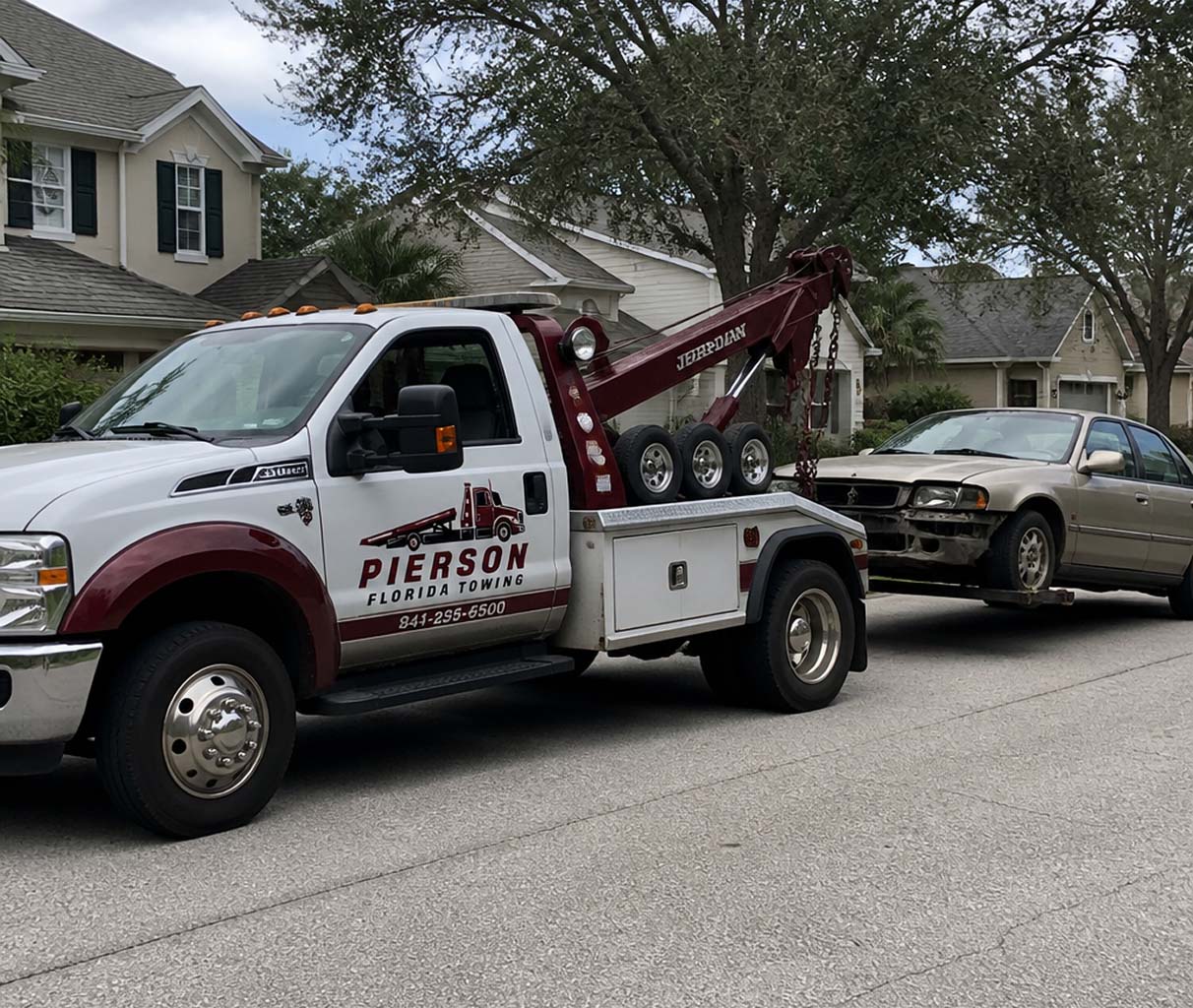
When the car is ready to go and the trouble is getting it out from behind the house, that is the part worth handing off. Junk car removal from Pierson Towing covers Pierson and north Volusia County, and a flatbed and a winch will get a vehicle that has not moved in years out to the road without tearing up the yard.
Florida Statute 319.30, Derelict motor vehicles, salvage, certificates of destruction, Florida Legislature. Florida Statute 705.103, Procedure for abandoned or lost property, Florida Legislature.