
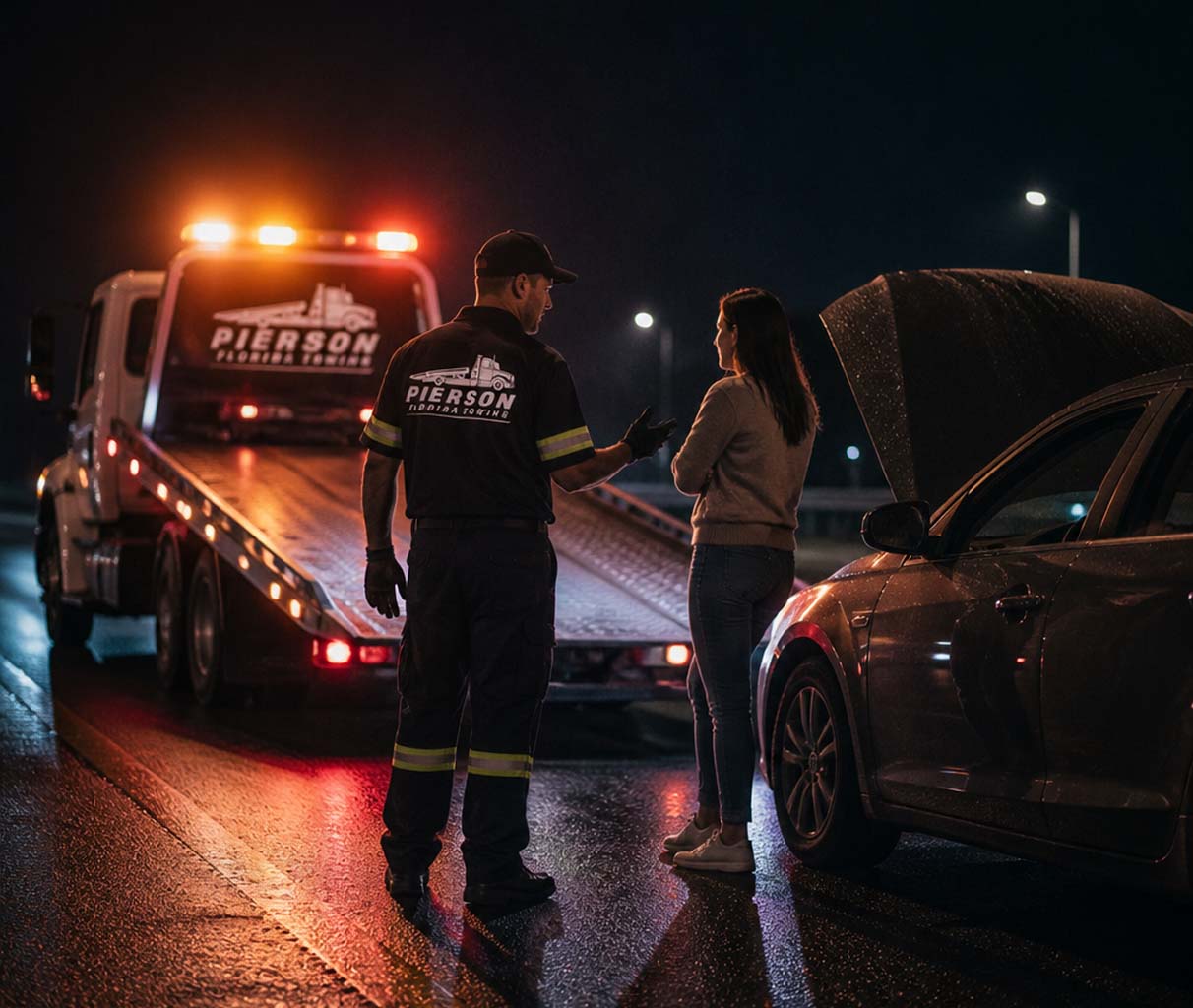
Florida issued more than 17,500 citations for failing to move over in 2024, and the state links 205 crashes that year to the same mistake. Almost none of those drivers set out to endanger anybody. They simply believed something about Florida's Move Over law that stopped being true, or was never true to begin with.
That gap matters more on a rural corridor than it does on an interstate. A crew working a breakdown on US-17 outside Pierson has a few feet of shoulder and a line of traffic that has not slowed down. Here are five things Volusia County drivers still get wrong, and what the law actually says.
Key Takeaways
- Florida's Move Over law is section 316.126 of the Florida Statutes, and it covers emergency, sanitation, utility, maintenance and disabled vehicles, not just police cars.
- Since January 1, 2025, the law protects any vehicle stopped on the roadside with hazard lights, flares or emergency signage, including a car with a flat tire.
- On a road with two or more lanes running your direction, you must vacate the lane closest to the stopped vehicle.
- On a two-lane road, or any time changing lanes is not safe, you must slow to 20 mph under the posted limit, or to 5 mph where the limit is 20 mph or less.
- A wrecker displaying amber rotating or flashing lights is named in the statute alongside police, fire and utility vehicles.
- A Move Over violation is a noncriminal moving violation that carries a fine, fees and points on your driving record.
Myth 1: The Move Over Law Only Applies to Police and Ambulances
Florida's Move Over law protects far more than emergency responders. Section 316.126 of the Florida Statutes lists authorized emergency vehicles, sanitation vehicles, utility service vehicles, wreckers displaying amber rotating or flashing lights, road and bridge maintenance or construction vehicles, and disabled motor vehicles. Every one of them gets the same protection.
The list also grew recently. The Florida Department of Highway Safety and Motor Vehicles states that as of January 1, 2025, the law reaches any vehicle parked on the side of the road with hazard lights flashing, emergency flares or visible emergency signage, and that even a disabled vehicle or a car with a flat tire is protected. A driver sitting on the shoulder of US-17 waiting on a tow is covered.
Myth 2: Moving Over Always Means Changing Lanes
On a two-lane road, the law asks you to slow down rather than change lanes. The statute splits the duty in two: on an interstate or other highway with two or more lanes traveling in your direction, you vacate the lane closest to the stopped vehicle. If that movement cannot be accomplished safely, or there is simply no second lane, the slow-down rule takes over.
The speeds are specific. Drop to 20 mph below the posted limit wherever that limit is 25 mph or higher, and travel at 5 mph where the posted limit is 20 mph or less. Many of the roads around Pierson, from County Road 3 to the two-lane stretches near the SR-40 junction, give you nothing to move into. Slowing down is the entire requirement there, and it is not a courtesy.
Myth 3: Hazard Lights Are What Switch the Law On
A stopped vehicle does not need its hazard lights on for the Move Over law to apply. The statute covers a disabled motor vehicle that is stopped and displaying warning or hazard lights, stopped and using emergency flares or posted emergency signage, or stopped with one or more persons visibly present.
That last clause carries real weight. A dead battery takes the hazard lights with it, and a driver standing beside a silent car is easy to miss at 55 mph. If you can see a person near a stopped vehicle on the shoulder, your duty to move over or slow down has already started.
Myth 4: A Tow Truck Is Just Another Work Vehicle
Wreckers are written into the Move Over statute by name. A wrecker displaying amber rotating or flashing lights while performing a recovery or loading on the roadside gets the same treatment as a patrol car with its lightbar running.
The reason is where the operator has to stand. The Emergency Responder Safety Institute notes that towing and recovery crews work roadway incidents both as a single unit and as part of a multi-agency response, and that traffic control has to be established before operations begin. On a narrow shoulder during an emergency tow in Pierson, there is nowhere to work except beside live traffic.
Myth 5: A Move Over Ticket Is a Paperwork Problem
A Move Over violation is a noncriminal traffic infraction punishable as a moving violation under chapter 318 of the Florida Statutes. FLHSMV states that it results in a fine, fees and points on your driving record, and Florida issued more than 17,500 of those citations in 2024 alone.
There is also a pattern worth knowing if you have a young driver in the house. FLHSMV reports that drivers aged 20 to 29 are statistically the most likely to violate the Move Over Act, and the least likely to move over or slow down as they approach a stopped emergency, service or disabled vehicle.
If You Are the One Stopped on the Shoulder
Your own safety comes down to what you do in the first minute. Get the vehicle as far off the pavement as it will roll, then work through the rest:
- Turn the hazards on the moment something feels wrong, not after you have stopped.
- Stay inside with your seatbelt fastened when traffic is close and fast. The car is better protection than the shoulder.
- If you do get out, exit on the side away from traffic and move well behind a guardrail or up the embankment.
- Never stand between your vehicle and oncoming traffic, and do not change a tire on the traffic side.
- Call for help with a cross street, mile marker or landmark rather than a map pin you cannot read back.
The rule is simpler than the myths. If anything is stopped on the shoulder, move over when you have a lane, and slow to 20 under the limit when you do not.
None of this asks much of a driver. One lane change, or a few seconds off the throttle, on a road where somebody is standing a few feet from your mirror. And if you are the one stopped on US-17 tonight, the shoulder is the worst place to wait it out. Pierson Towing dispatches around the clock for emergency towing and roadside assistance across Pierson, DeLeon Springs, Barberville, Seville and the rest of north Volusia County.
Common Questions About Florida's Move Over Law
Does the Move Over law apply to disabled vehicles in Florida?
Yes. FLHSMV states that as of January 1, 2025, Florida's Move Over law covers any vehicle parked on the side of the road with hazard lights flashing, emergency flares or visible emergency signage, including a disabled vehicle or a car with a flat tire.
How much do you have to slow down under Florida's Move Over law?
Slow to 20 mph below the posted speed limit when that limit is 25 mph or higher, or travel at 5 mph when the posted limit is 20 mph or less. That rule applies on two-lane roads and any time moving over cannot be done safely.
Is a tow truck covered by Florida's Move Over law?
Yes. Section 316.126 names a wrecker displaying amber rotating or flashing lights while performing a recovery or loading on the roadside, alongside emergency, utility and maintenance vehicles.
Florida Department of Highway Safety and Motor Vehicles, Move Over, Florida! · Section 316.126, Florida Statutes · Emergency Responder Safety Institute, Towing and Recovery