
The water goes down faster than people expect. A ditch along US-17 that was moving like a creek at two in the morning is a muddy stripe by breakfast, and the car that sat in it overnight looks almost normal again. That is the moment flood damage decisions get made badly, because a car that has been underwater rarely looks like a car that has been underwater. What you do in the first day, and what you avoid doing at all, separates a repairable vehicle from an expensive lesson.
Key Takeaways
- Do not start, crank, or jump a vehicle that has been sitting in water until the engine intake and the oil have been checked.
- Water depth matters more than how long the car sat. Floodwater above the rocker panels reaches wiring, control modules, and airbag components.
- Florida brands the title of a vehicle declared a total loss from water damage, and sellers must disclose it in writing before the sale.
- A flooded car should leave on a flatbed rather than being driven or towed on its own wheels.
- The Atlantic hurricane season peaks on September 10, the window when most Volusia County flood damage happens.
- Twelve inches of moving water is enough to carry away most cars, so never drive into standing water to reach one.
Water Depth Decides Almost Everything
How far up the car the water reached is the single most useful fact about a flooded vehicle, and it is the first thing a shop or an adjuster will ask. Water that stopped below the floor pan is usually a cleaning problem. Water that reached the bottom of the doors has been into carpet, seat rails, and the harnesses that run under them. Water over the dash has touched control modules, the airbag system, and in most cases the engine's air intake, and at that point the vehicle is rarely worth repairing regardless of how it looks parked in the sun.
Find that line before anything gets cleaned. Silt leaves a tide mark on the inside of the door, in the seat foam, and in the spare tire well, and a few phone photos of it will carry more weight in an insurance conversation than any description you can give over the phone. Check the well under the trunk carpet even when the cabin looks dry, because it fills first and drains last.
The Worst Thing You Can Do Is Turn the Key
Starting a flooded engine is what converts a repair into a replacement. Water does not compress. If any has been drawn into a cylinder through the intake, the first rotation of the crankshaft tries to squeeze it and bends or snaps a connecting rod instead. That failure takes about one second and cannot be undone.
Jump-starting carries its own version of the problem. Silt and salt make floodwater conductive, and pushing current through a wet electrical system can short modules that were otherwise recoverable, along with any chance of a clean diagnosis afterward. Disconnect the negative battery terminal if you can reach it safely and leave the rest alone. Pulling the engine oil dipstick answers the important question without risking anything: oil contaminated with water looks milky or coffee-colored rather than amber, and that appearance means the engine does not get started until it has been opened up.
Moving Water Is Still the Larger Danger
Most flood damage to vehicles around here happens while they are parked, and most flood deaths happen while they are moving. The National Weather Service puts the numbers plainly: six inches of fast-moving water can knock an adult off their feet, it takes just twelve inches of rushing water to carry away most cars, and two feet will move SUVs and trucks. More than half of all flood-related drownings happen when a vehicle is driven into hazardous flood water.
Rural roads make that worse rather than better. A two-lane stretch north of Pierson with a shallow ditch on either side gives no visual cue for where the pavement ends once water covers it, and a washed-out shoulder looks exactly like a flooded one. Water moving across a road is also doing something to what sits under the road. The guidance holds whether the water is ankle deep or knee deep: turn around, take the longer route, and do not become the reason a recovery truck has to come out in the dark.
Florida Puts Flood Damage on the Title
A vehicle declared a total loss because of water damage does not quietly return to the market in Florida. Under Florida Statute 319.14, a flood vehicle is one declared a total loss under section 319.30(3)(a) as a result of damage caused by water, and the department stamps the vehicle's prior condition in a conspicuous place on the certificate of title. Anyone selling, exchanging, or transferring such a vehicle has to disclose that in writing to the purchaser before the transaction is completed, and misrepresenting it in an advertisement is a second-degree misdemeanor.
That cuts two ways for an owner. If your car is totaled by flooding, the brand is not aimed at you personally; it follows the vehicle for the rest of its life. And if you are shopping for a replacement after a storm, it is the reason to read a title carefully rather than trusting a clean-looking interior, because storm seasons reliably push water-damaged cars into the used market at prices that look like bargains.
The Timing Is Predictable Even When the Storm Is Not
Florida's flood risk runs on a calendar. The National Hurricane Center puts the Atlantic season from June 1 to November 30, with the statistical peak on September 10 and most activity between mid-August and mid-October. Volusia County sits inside that window with two separate problems: rain that falls here, and water that arrives later from somewhere else.
The second one catches people out. The St. Johns River runs along the western edge of the county past Astor and DeLand, where the U.S. Geological Survey has gauged it since 1932, and a basin that size does not crest the night of the storm. It can keep rising for days after the sky clears, which is how a driveway that stayed dry through a hurricane ends up under water the following week. If you live near the river or in a low pocket off SR-40, moving a vehicle to higher ground is worth doing before the rain rather than after the forecast changes.
Getting It Moved Without Adding Damage
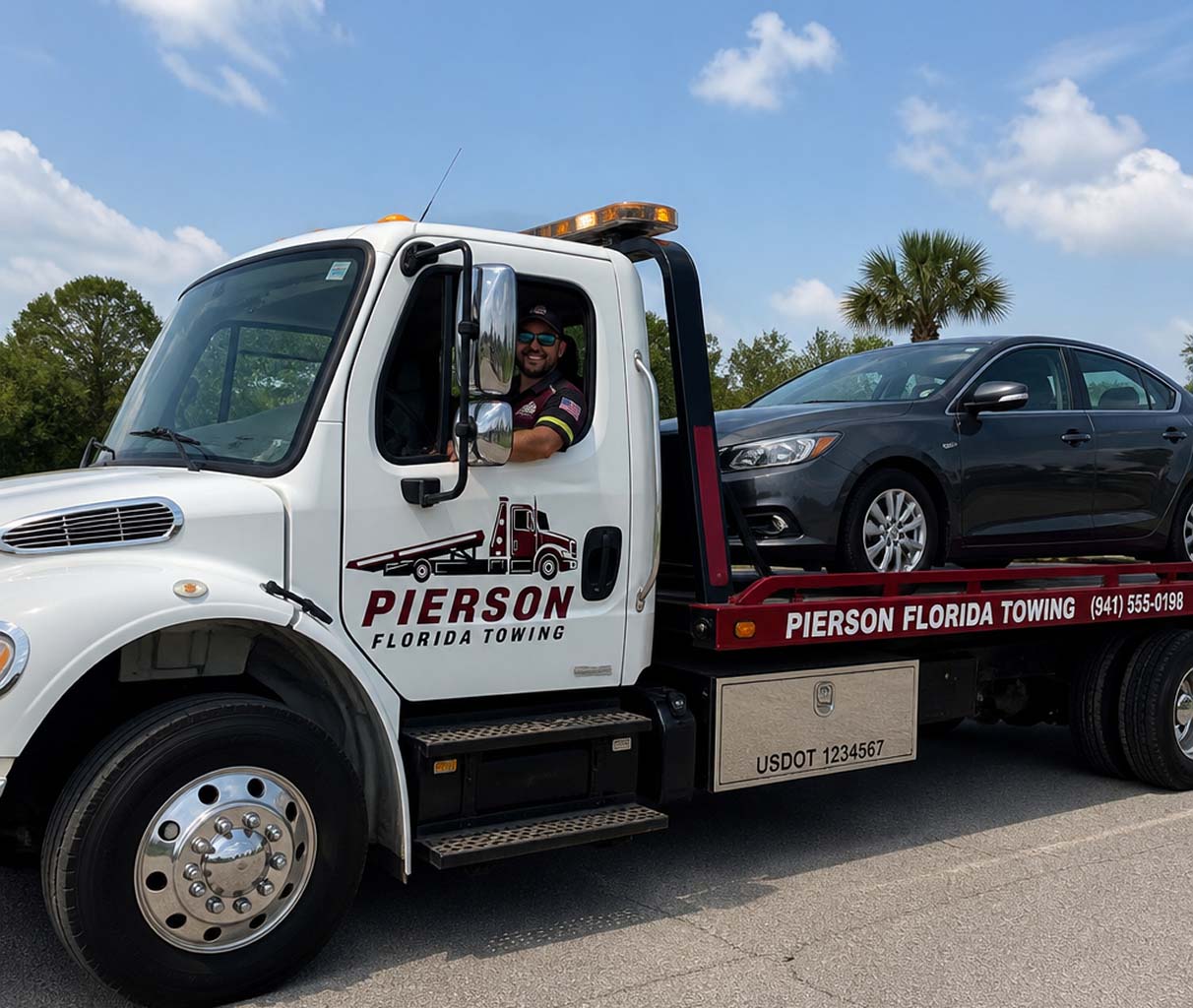
A flooded vehicle should leave on a flatbed. Towing it on its own wheels spins a transmission that may be full of water and drags wet brakes and bearings with silt in them, and driving it anywhere is out of the question for the reasons above. A flatbed also means the car reaches a shop or a salvage yard in the condition the adjuster expects to see, which keeps the claim straightforward. Flatbed towing is the right call here even for a car that technically still rolls.
Say on the phone that the vehicle has been in water and roughly how deep, because it changes the job. A car that has been sitting in soft ground or a ditch since the water dropped has to be winched before it can be loaded, and that is different equipment. Get the paperwork and anything valuable out of the cabin first if it is safe to do so, and otherwise let the vehicle go as it is rather than cleaning it up.
What to Settle Before the Water Is Gone
Three decisions carry the whole thing. First, whether anyone has tried to start it, which is worth confirming out loud with everyone who has a key. Second, the water line, photographed before any cleanup, because that is what decides whether you are looking at a detail job or a total loss. Third, how the car gets moved, which should be a flatbed in every case where water reached the floor. Everything after that is insurance and paperwork, and it goes far more smoothly when the first three were handled properly.
When the water drops and the car has to come out of a ditch or off a soaked driveway without being driven, that is the point to hand it over. Pierson Towing runs flatbed work across Pierson and north Volusia County, and handles junk car removal for the vehicles that do not come back from a storm.
Turn Around Don't Drown, National Weather Service. Tropical Cyclone Climatology, NOAA National Hurricane Center. Florida Statute 319.14, Sale of a motor vehicle with a rebuilt or flood title, Florida Legislature. St. Johns River near DeLand gauge, U.S. Geological Survey.