Should your car ride flat on a bed, or is a wheel-lift fine? It is one of the first things drivers wonder when they call for a tow around Pierson, and the honest answer is that flatbed vs. wheel-lift towing is less about which truck is better and more about which one fits the vehicle sitting on the shoulder. Choose wrong and you risk a scraped bumper or a damaged drivetrain; choose right and the car reaches the shop in exactly the shape it left. Here is how the two methods differ and how to tell which one your vehicle needs.
A Wheel-Lift Tow Lifts Two Wheels and Rolls the Other Two
A wheel-lift tow raises one axle off the ground with a metal yoke while the opposite pair of wheels stays on the pavement and rolls along behind the truck. It is quick to hook up, light on its feet, and well suited to short in-town moves and tight spots where a larger truck cannot fit. For a running front- or rear-wheel-drive car that needs to travel a few miles, it is often the fastest way to get moving.
The trade-off is that two of the vehicle's wheels are still turning on the road for the whole trip. That is fine for many cars, but it becomes a problem for all-wheel-drive vehicles, cars with locked or flat wheels, and anything sitting low enough to catch on the lift. In those cases the rolling wheels are exactly what you do not want.
A Flatbed Carries the Whole Vehicle Off the Ground
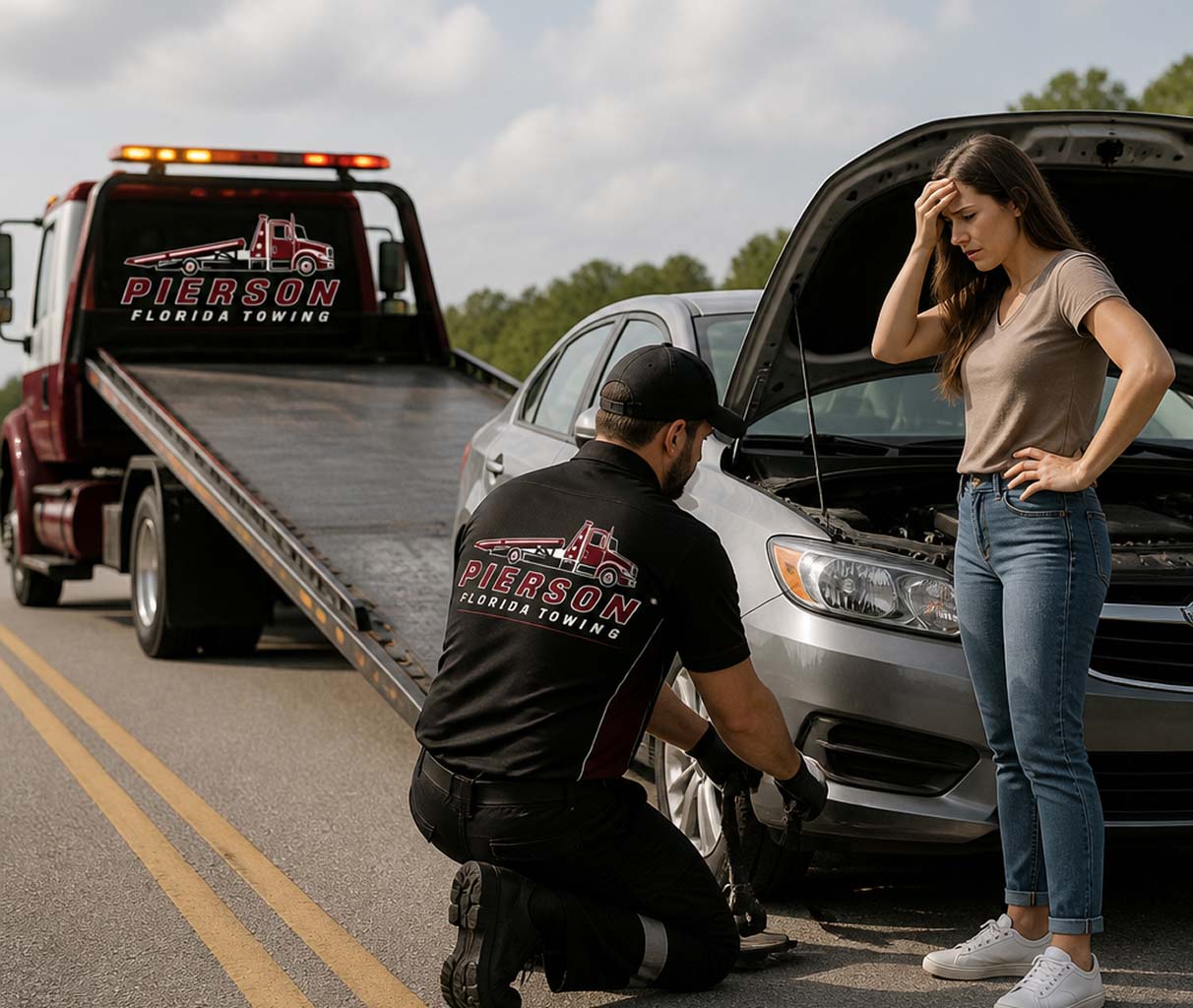
A flatbed, also called a car carrier or rollback, tilts its bed to the pavement so the entire vehicle can be winched up and carried with all four wheels off the ground. Equipment makers such as Miller Industries build both flatbed carriers and wheel-lift wreckers precisely because different situations call for different tools. Because nothing on the car touches the road during transport, the flatbed is the damage-free choice for a wide range of vehicles.
That full-support design is why a flatbed handles the hardest cases: all-wheel-drive cars, lowered or high-performance vehicles, luxury and collector cars, and anything that will not roll because it is wrecked or has a seized wheel. It costs a little more than a basic wheel-lift call, but for the right vehicle it is cheaper than the repair a wrong tow can cause.
Where a Tow Dolly Fits Between the Two
There is a third option worth knowing about: a tow dolly, a small two-wheel trailer that carries the front wheels of a vehicle while the rear wheels stay on the road. It sits between a wheel-lift and a flatbed in both cost and protection, and it is most often used for front-wheel-drive cars on longer moves. For an all-wheel-drive vehicle a dolly carries the same risk as a wheel-lift, because two wheels are still rolling, so it does not solve the drivetrain problem that a flatbed does.
Most everyday roadside calls come down to a wheel-lift or a flatbed, but if a company mentions a dolly, it helps to know what it is. The safest rule remains the same: the more of the vehicle that is carried rather than rolled, the lower the risk to the drivetrain and the body.
The Differences That Actually Matter on the Road
| Dimension | Wheel-lift | Flatbed |
|---|---|---|
| Wheels on the ground | Two | None |
| Best for | Running FWD or RWD cars, short moves | AWD, lowered, luxury, or non-running vehicles |
| Maneuverability | Excellent in tight spots | Needs more room to load and turn |
| Damage risk | Low for the right vehicle | Lowest overall |
| Typical cost | Lower | Slightly higher |
| Long-distance transport | Workable | Preferred |
Read down the table and a pattern appears: the wheel-lift wins on speed and tight-space access, while the flatbed wins on protection and versatility. Neither is the right answer for every car, which is exactly why a good dispatcher asks about your vehicle before sending a truck.
Some Vehicles Should Always Ride on a Flatbed
A few types of vehicle should ride on a flatbed nearly every time. All-wheel-drive and four-wheel-drive vehicles can suffer expensive drivetrain damage if their wheels spin during transport, which is why drivetrain and manufacturer guidance generally calls for carrying them fully off the ground. Lowered sports cars, luxury and collector vehicles, and any car that is wrecked or will not roll belong on a bed as well, where nothing drags or bears weight the wrong way.
There is a legal angle too. Under Florida Statute 715.07, a towing operator is liable for damage caused when a vehicle is not handled with the standard of reasonable care, and for a fragile or all-wheel-drive vehicle a flatbed is often the most defensible way to meet that standard. When a car has been in a crash, recovery and transport rules under Statute 713.78 come into play as well, and a flatbed keeps a damaged vehicle stable from the scene to the shop.
Motorcycles, ATVs, and small trailers belong on a flatbed too, because there is no safe way to raise them by a single pair of wheels. The same is true of a vehicle with two flat tires on one side or a broken axle. Whenever a car or bike cannot roll straight and true on the wheels left touching the road, carrying it fully off the ground is the only method that will not add fresh damage during the trip.
When a Wheel-Lift Is the Right Tool
A wheel-lift earns its keep on everyday calls. A running front-wheel-drive commuter that needs to move a few miles to a garage, a car boxed into a tight parking lot in DeLand, or a quick relocation off a busy stretch of US-17 are all ideal wheel-lift work. The smaller footprint lets the driver reach vehicles a full-size carrier would struggle to position near.
The key is matching the method to the vehicle and the trip. For a standard car making a short local move, a wheel-lift is fast and economical; the moment all-wheel drive, low clearance, or real damage enters the picture, the flatbed becomes the safer call. A dispatcher who knows the roads across north Volusia County can make that judgment in seconds.
Speed can matter as well. When a car is blocking a lane after a minor breakdown, a wheel-lift often clears the road faster because it hooks up in less space and time, which lowers the risk to you and to passing drivers. Once the vehicle is safely off the road, there is time to decide whether it should finish the trip on the same truck or move to a flatbed for a longer haul.
What Volusia County Roads and Weather Add to the Choice
Local conditions quietly push the decision one way or the other. Summer thunderstorms leave shoulders and unpaved lanes soft across north Volusia County, and a flatbed that loads a car cleanly from firmer ground often beats a wheel-lift that has to work in the mud. On narrow fern-farm roads around Pierson and tight commercial lots off US-17, the wheel-lift's smaller turning footprint can be the only thing that reaches the vehicle.
Distance matters as well. A short repositioning after a fender-bender in DeLand is straightforward wheel-lift work, while a longer haul along US-17 or west toward State Road 40 is usually more comfortable on a flatbed, where the vehicle is fully carried the whole way. A dispatcher who knows these roads can weigh the surface, the space, and the trip together instead of defaulting to one truck.
Matching the Truck to the Car in Your Driveway
When you strip it down, the choice comes to four questions: does the car roll, is it all-wheel drive, does it sit low, and how far is it going? A running, standard-clearance, two-wheel-drive car on a short hop is comfortable on a wheel-lift, while all-wheel drive, low ground clearance, damage, or a long haul all point to a flatbed. When any of those apply, or when you simply are not sure, the flatbed is the low-risk default because it removes the road from the equation entirely. If you are weighing flatbed vs. wheel-lift towing for your own vehicle, tell the dispatcher the year, make, and drivetrain and let them choose; Pierson Towing runs both flatbed and wheel-lift equipment and can send the right one anywhere across north Volusia County.
Miller Industries, towing and recovery equipment manufacturer (car carriers and wreckers) · Florida Statute 715.07, Vehicles or vessels parked on private property; towing (Florida Legislature) · Florida Statute 713.78, Liens for recovering, towing, or storing vehicles and vessels (Florida Legislature)