
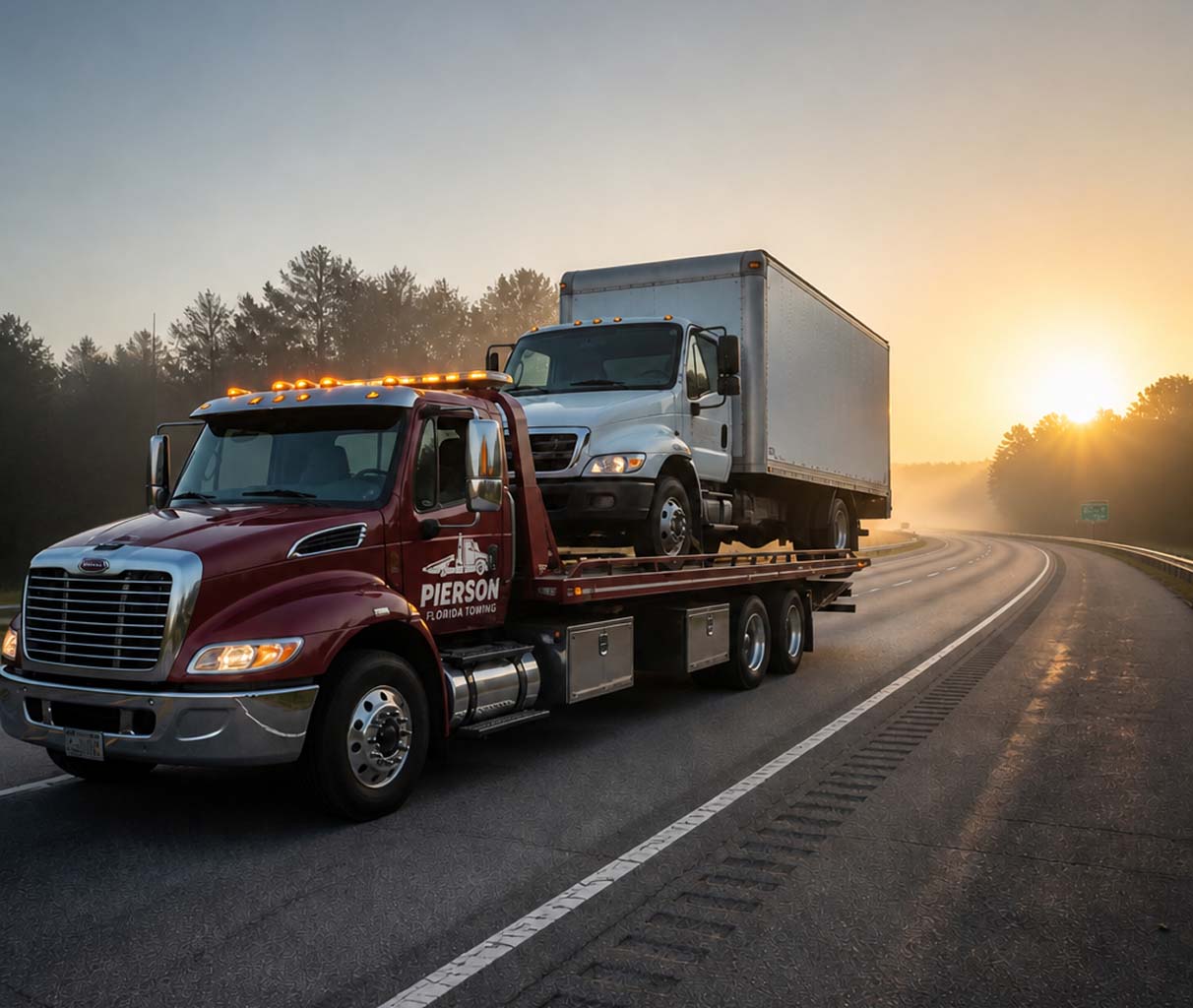
A loaded box truck stopped in the northbound lane of US-17 outside Barberville is a different kind of problem from a car with a flat. It is a federally regulated event with a clock attached, it is blocking a corridor with no practical alternate route for several miles, and the wrong recovery decision can cost more than the repair that caused it. Whether you drive the truck or dispatch it from an office three states away, the first ten minutes decide most of what follows.
Key Takeaways
- Hazard flashers go on immediately and stay on until the warning devices are placed.
- Federal rules give the driver 10 minutes from stopping to set out warning devices.
- Standard placement is one device about 10 feet from the vehicle, one 100 feet ahead, and one 100 feet behind.
- A vehicle found unsafe en route may continue only to the nearest safe repair point, and only when that is less hazardous than leaving it on the highway.
- Dispatch needs gross weight, axle configuration, length, cargo, and whether the wheels turn before a truck can be assigned.
- US-17 through north Volusia is two-lane with narrow shoulders, so a blocked lane is a corridor closure in practice.
1. Flashers, Then Warning Devices, Within Ten Minutes
Federal rules are specific about what happens when a commercial motor vehicle stops on the traveled portion of a highway or the shoulder. Under 49 C.F.R. 392.22, the driver must immediately activate the vehicular hazard warning signal flashers and continue the flashing until the required warning devices are placed. Those devices go out within 10 minutes of stopping.
Placement in the general case is three devices: one on the traffic side about 10 feet from the vehicle in the direction of approaching traffic, one at roughly 100 feet in the center of the occupied lane or shoulder toward approaching traffic, and one at roughly 100 feet in the direction away from approaching traffic. The regulation sets out different arrangements for divided highways, hills and curves, business districts, and vehicles carrying flammable materials.
On a two-lane rural road that placement is not a formality. A driver coming over a rise south of Seville at 55 miles per hour needs the 100-foot device to have any useful reaction time at all, and the shoulder is usually too narrow for a passing vehicle to clear the truck without crossing the centerline.
2. Decide Whether the Truck Should Move at All
The instinct is to limp to the next exit or the nearest shop, and federal rules allow that only in narrow circumstances. Under 49 C.F.R. 396.7, a motor vehicle must not be operated in a condition likely to cause an accident or a breakdown, and when an unsafe condition is discovered while the vehicle is on a highway it may continue only to the nearest place where repairs can safely be made, and only if that operation is less hazardous to the public than leaving the vehicle where it is.
That is a judgment call, and it is one that gets second-guessed after the fact. Air loss, a wheel-end problem, a steering complaint, or anything smelling of overheated brakes is not a limp-home situation. A shredded accessory belt on a quiet stretch with a wide shoulder might be. When the decision is close, the cheaper error is stopping, because a recovery from the roadside costs less than a recovery from the tree line.
3. Give Dispatch the Numbers That Pick the Truck
Heavy recovery is assigned on physics, not on symptoms. The details that decide which unit rolls are gross vehicle weight, axle configuration, overall length, whether the wheels turn freely, whether the air system holds pressure, what the cargo is, and what surface the vehicle is sitting on. Florida Statute 316.515 sets the dimensional frame around all of it: straight trucks up to 40 feet, truck-trailer combinations up to 68 feet, semitrailers generally up to 48 feet, and a height limit of 13 feet 6 inches inclusive of the load.
Two other things belong in that first call. Say whether the trailer is loaded and with what, because a loaded reefer and an empty dry van are not the same recovery. And say precisely where the truck is. On US-17 there are long gaps between cross streets, so a mile marker, a named cross road, or GPS coordinates read off a phone is worth more than a description of the scenery.
4. Understand What a Heavy Recovery Actually Involves
A disabled tractor-trailer rarely gets hooked and pulled the way a car does. Depending on the failure, the work can involve caging the air brakes manually, lifting a drive axle so the driveline is not turning, uncoupling the trailer so the two units move separately, or bringing a rotator if the vehicle has left the pavement. Each of those adds time, and several of them require a second truck on scene.
This is also why a phone estimate is a range rather than a number. An operator who has not seen the scene does not know whether the vehicle rolls, whether the shoulder will hold a support jack, or whether the load has shifted against the trailer wall. The useful question to ask is not what it will cost, but what the recovery plan is and what would change it.
5. Handle the Cargo and the Clock Deliberately
Cargo is its own decision. A trailer that cannot roll may need to be offloaded onto another unit, which means a second truck, a dock or a level staging area, and daylight. Perishables and temperature-controlled freight push that decision earlier, because a reefer running on its own fuel while the tractor is dead is spending a countdown nobody is watching.
Hours of service keep running through all of it. A driver who is going to run out of time at the roadside needs a relief plan started early, not after the wrecker arrives. And if the truck is heading to a repair facility rather than back to a terminal, confirm the facility can receive it at the hour it will actually land, because a heavy unit dropped outside a closed gate is a second problem rather than the end of the first one.
6. Know What North Volusia Adds to the Job
Local geography shapes almost every commercial recovery here. US-17 is the main north-south route through Pierson, Barberville, and Seville, and it is two lanes with soft, narrow shoulders and drainage ditches close to the pavement. There is no breakdown lane in the interstate sense, so a truck that stops in the lane closes the corridor, and one that eases onto the shoulder often puts its right-side wheels into ground that will not carry the weight.
The traffic mix matters too. This stretch carries agricultural and log truck traffic alongside regular through traffic, which means the vehicles most likely to be behind a stopped rig are the ones that need the most distance to stop. Add the afternoon storms that soak the shoulders through the summer and a routine tow becomes a recovery, with a winch and matting involved, simply because the ground gave up under a support point.
Minutes One Through Ten Are the Whole Job
Everything expensive about a commercial breakdown is decided before the wrecker is even assigned. Flashers and triangles inside ten minutes, an honest call on whether the vehicle should move at all under 396.7, and a dispatch call carrying weight, length, axle configuration, cargo, and an exact location. Those three cover most of the distance between a roadside repair, a straightforward tow, and a full recovery with a rotator and a lane closure.
The one worth rehearsing is the second. Drivers under schedule pressure move trucks that should have stayed put, and the recovery that follows is the one that ends up in a report. For a unit stopped on US-17 in north Volusia County, Pierson Towing runs heavy-duty towing and emergency dispatch for tractors, box trucks, and buses, and knows which stretches of shoulder will hold a truck and which will not.
49 C.F.R. 392.22, Emergency signals, stopped commercial motor vehicles, eCFR. 49 C.F.R. 396.7, Unsafe operations forbidden, eCFR. Florida Statute 316.515, Length, width, and height of vehicles, Florida Legislature.