Hook an electric car up to a tow truck the way you would an old sedan, and you can do real damage before the truck even reaches the highway. Electric vehicles are turning up in driveways across Pierson and north Volusia County, and most of them cannot be towed the way gas cars have been for decades. The short version: almost every EV belongs on a flatbed, with the wheels off the ground. Here is why, and what to tell the driver you call when an EV will not move.
Key Takeaways
- Almost every electric vehicle should be transported on a flatbed, with all four wheels off the ground.
- Towing an EV with its drive wheels on the road can spin the electric motor, which can overheat and, in rare cases, start a fire.
- "Tow mode" and shifting to neutral release the parking brake, but they do not disconnect the motor, so neither is a substitute for a flatbed.
- Most EV makers warn that damage from improper towing is not covered under warranty.
- EVs are heavier and sit lower than similar gas cars, so loading one takes the right equipment and the right attachment points.
- When you call, say it is an electric vehicle and give the make and model, so a flatbed is dispatched the first time.
Can You Tow an Electric Car the Same Way as a Gas Car?
Usually not. A conventional gas car with the engine off can often be moved on a wheel-lift or a dolly with two wheels still rolling, at least for a short distance. An electric vehicle generally cannot. The safe default for nearly every EV is a flatbed, where the car rides fully off the ground and nothing in the drivetrain is turning. Tesla, for one, states that a flatbed truck or comparable transport vehicle is the recommended method of transporting its cars, and warns owners in its instructions for transporters never to move the vehicle with the tires in a position where they can spin. The reason lives in how electric drivetrains work, so it is worth understanding before you ever need a tow.
Why Does an EV Have to Ride on a Flatbed?
Because the wheels and the motor are permanently connected. On most EVs there is no neutral that fully separates the drive wheels from the electric motor the way a gas car's transmission can. When the wheels roll, they turn the motor, and a spinning motor generates electricity. Electric cars use that effect on purpose: the U.S. Department of Energy explains that regenerative braking recovers energy as the motor helps slow the car. The trouble comes when the car is towed with its power off and nothing is managing that generated current. Tesla warns that moving the car with its tires able to spin can lead to significant damage and overheating, and that in rare cases extreme overheating may cause surrounding components to ignite. A flatbed avoids all of it by keeping every wheel still.
Doesn't Tow Mode or Neutral Make It Safe to Roll?
Not for a real tow. Many EVs have a transport or tow mode that releases the electronic parking brake and lets the car roll a few feet, say to nudge it onto a flatbed or out of a tight spot. That is what it is for. It does not disconnect the motor, and it is not permission to flat-tow the car down the road on its own wheels or to drag it behind an RV. Manufacturers are specific about that difference, and the distance is the whole point: rolling a car a few feet onto a bed is fine, while towing it miles on the ground is not. If anyone suggests simply putting it in neutral and hooking the front wheels up, that is the moment to stop and ask for a flatbed instead.
Does Towing an EV the Wrong Way Really Cause Damage?
Yes, and it is expensive. Forcing the drive wheels to spin during a tow pushes current through the motor and power electronics that are not built to handle it while the car is off, which can overheat the motor, the inverter, or related parts. Those are among the costliest components in the whole vehicle. Just as important, carmakers are clear that they will not pay for it: Tesla states plainly that damage caused by transporting the car incorrectly is not covered by warranty, and other EV makers take the same position in their owner's manuals. A tow meant to save a few dollars on equipment can turn into a repair bill larger than the car's entire roadside history. On an EV, the flatbed is not the premium option. It is the only safe one.
What Makes EVs Heavier and Harder to Load?
The battery. A large pack can add hundreds of pounds over a comparable gas car, which changes how the vehicle has to be handled and secured on the bed. That weight matters for the tow itself, too: the flatbed has to be rated for the load, and a heavier car rides and brakes differently once it is up on the deck. EVs also tend to sit lower and have smooth, covered underbodies, so there are fewer places to safely hook a strap or a winch line, and the wrong attachment point can damage the battery enclosure or the body. An operator who tows EVs knows to secure the car by the wheels or the manufacturer's rated points rather than the suspension or a random spot on the underside, and to load a low car without scraping it on the ramp. This is the practical reason an EV tow is not a job for whatever truck happens to be closest. It is a job for the right truck and someone who has done it before.
What Should You Do If Your EV Stops Near Pierson?
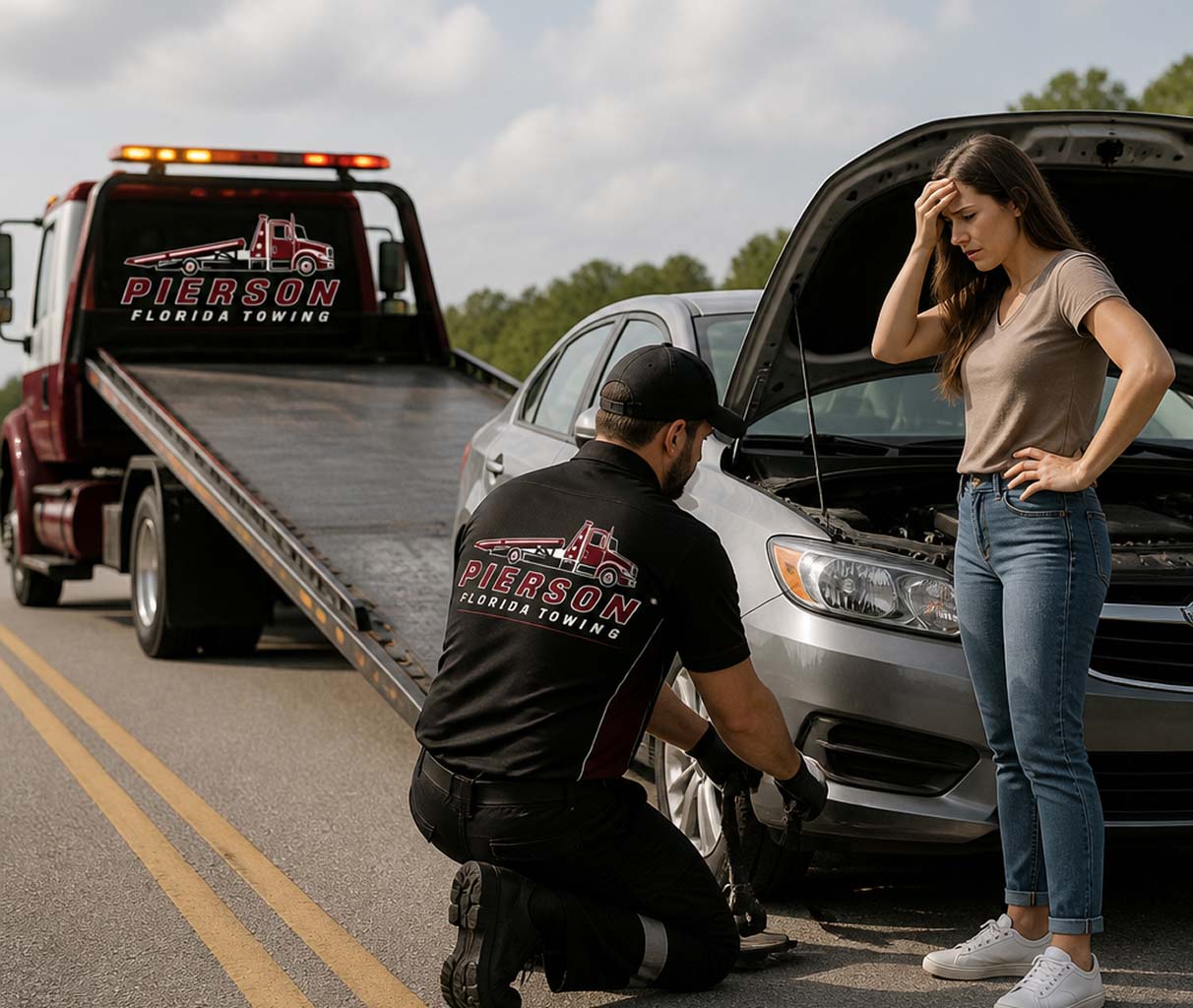
Get the car out of traffic and make the call specific. If you can still roll, ease onto the shoulder of US-17 or off at the nearest exit, switch on your hazard lights, and straighten the wheels. Then, when you call for a tow, lead with the fact that it is an electric vehicle and give the make and model, so a flatbed is sent the first time instead of a wheel-lift that cannot do the job. Mention whether the car was in a crash or sat in floodwater, because a damaged high-voltage battery needs extra care and distance. Tell the dispatcher where the car is in plain terms, a mile marker or a cross street, so the driver reaches you fast. Our flatbed towing crew handles EVs across north Volusia County, and getting those details up front is what keeps your car on the right truck.
EV Towing Questions Volusia County Drivers Ask
Can a hybrid be flat-towed like an old gas car?
Not automatically. Many hybrids and plug-in hybrids share the same no-true-neutral limitation as full EVs and are also meant to ride on a flatbed. Check the owner's manual, and when in doubt, ask for a flatbed rather than risk it.
Can I roll my EV a short distance to get it off the road?
Usually yes, briefly. Most EVs have a tow or transport mode that lets the car roll a few feet at low speed to reach a safe spot or a waiting flatbed. That is different from towing it on its wheels down the road, which is the part that causes damage.
Will my warranty cover damage from a bad tow?
Generally no. Manufacturers such as Tesla state that damage from transporting the vehicle incorrectly is not covered, which is exactly why insisting on a flatbed protects you twice: once for the car, and once for the repair bill.
Is it more expensive to tow an EV?
It can cost a little more, because it requires a flatbed and careful loading rather than a quick hookup. But that difference is minor next to the cost of repairing a motor or inverter damaged by the wrong method.
Tesla, Model S Owner's Manual: Instructions for Transporters. U.S. Department of Energy, Alternative Fuels Data Center, All-Electric Vehicles.